


The arithmetic mean of a set of values is the quantity commonly called "the" mean or the average. Given a set of samples  , the arithmetic mean is
 |
(1)
|
It can be computed in the Wolfram Language using Mean[list].
The arithmetic mean is the special case  of the power mean and is one
of the Pythagorean means.
of the power mean and is one
of the Pythagorean means.
When viewed as an estimator for the mean of the underlying distribution (known as the population mean), the arithmetic mean of a sample is called the sample mean.
For a continuous distribution function, the arithmetic mean of the population, denoted  ,
,  ,
,  , or
, or  and called the population
mean of the distribution, is given by
and called the population
mean of the distribution, is given by
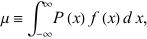 |
(2)
|
where  is the expectation value. Similarly, for a discrete distribution,
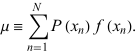 |
(3)
|
The arithmetic mean satisfies
 |
(4)
|
 |
(5)
|
and
 |
(6)
|
if  and
and  are independent statistics. The "sample
mean," which is the mean estimated from a statistical sample, is an unbiased
estimator for the population mean.
are independent statistics. The "sample
mean," which is the mean estimated from a statistical sample, is an unbiased
estimator for the population mean.
Hoehn and Niven (1985) show that
 |
(7)
|
for any constant  .
For positive arguments, the arithmetic mean satisfies
.
For positive arguments, the arithmetic mean satisfies
 |
(8)
|
where  is the geometric mean and
  is the harmonic mean (Hardy
et al. 1952, Mitrinović 1970, Beckenbach and Bellman 1983, Bullen et
al. 1988, Mitrinović et al. 1993, Alzer 1996). This can be shown
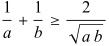
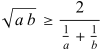
as follows. For
is the harmonic mean (Hardy
et al. 1952, Mitrinović 1970, Beckenbach and Bellman 1983, Bullen et
al. 1988, Mitrinović et al. 1993, Alzer 1996). This can be shown
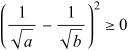
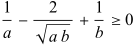
as follows. For  ,
,
 |
(9)
|
 |
(10)
|
 |
(11)
|
 |
(12)
|
 |
(13)
|
with equality iff  . To show the second part of the inequality,
 |
(14)
|
 |
(15)
|
 |
(16)
|
with equality iff  . Combining (13) and (16)
then gives (8).
. Combining (13) and (16)
then gives (8).
Given  independent random normally distributed variates
  , each with population mean
  and variance
  ,
,
 |
(17)
|
 |  |  |
(18)
|
 |  |  |
(19)
|
 |  |  |
(20)
|
 |  |  |
(21)
|
 |  |  |
(22)
|
so the sample mean is an unbiased estimator of the population mean. However, the distribution of  depends on the sample size. For large samples,
  is approximately normal.
For small samples, Student's t-distribution
should be used.
is approximately normal.
For small samples, Student's t-distribution
should be used.
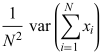
The variance of the sample mean is independent of the distribution, and is given by
 |  |  |
(23)
|
 |  |  |
(24)
|
 |  |  |
(25)
|
 |  |  |
(26)
|
 |  |  |
(27)
|
For small samples, the sample mean is a more efficient estimator of the population mean than the statistical median, and approximately
 less (Kenney and Keeping 1962, p. 211).
Here, an estimator of a parameter of a probability distribution is said to be more
efficient than another one if it has a smaller variance.
In this case, the variance of the sample mean is generally less than the variance
of the sample median. The relative efficiency of two estimators is the ratio of this
variance.
less (Kenney and Keeping 1962, p. 211).
Here, an estimator of a parameter of a probability distribution is said to be more
efficient than another one if it has a smaller variance.
In this case, the variance of the sample mean is generally less than the variance
of the sample median. The relative efficiency of two estimators is the ratio of this
variance.
A general expression that often holds approximately is
 |
(28)
|
(Kenney and Keeping 1962).
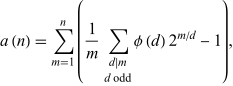
Let  be the number of nonempty subsets of
  whose arithmetic mean is an integer.
The first few values are 1, 2, 5, 8, 15, 26, 45, 76, 135, 238, ... (OEIS A051293),
and
whose arithmetic mean is an integer.
The first few values are 1, 2, 5, 8, 15, 26, 45, 76, 135, 238, ... (OEIS A051293),
and
 |
(29)
|
where  is the totient function. The parity
identity
is the totient function. The parity
identity
 |
(30)
|
was Problem A3 of the 63rd William Lowell Putnam Mathematical Competition (Putnam 2003). The conjectured asymptotic expansion
 |
(31)
|
was proved by an AI-generated proof formally verified in Lean (Adamczewski 2026, Epoch AI 2026).
