

For a set of  numbers or values of a discrete distribution
  , ...,
  , the root-mean-square (abbreviated "RMS" and sometimes
called the quadratic mean), is the square root of
mean of the values
, the root-mean-square (abbreviated "RMS" and sometimes
called the quadratic mean), is the square root of
mean of the values  ,
namely
,
namely
 |  | 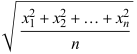 |
(1)
|
 |  |  |
(2)
|
 |  |  |
(3)
|
where  denotes the mean of the values
  .
.
For a variate  from a continuous distribution
  ,
,
![x_(RMS)=sqrt((int[P(x)]^2dx)/(intP(x)dx)),](/images/equations/Root-Mean-Square/NumberedEquation1.svg) |
(4)
|
where the integrals are taken over the domain of the distribution. Similarly, for a function  periodic over the interval
  ], the root-mean-square is defined as
![f_(RMS)=sqrt(1/(T_2-T_1)int_(T_1)^(T_2)[f(t)]^2dt).](/images/equations/Root-Mean-Square/NumberedEquation2.svg) |
(5)
|
The root-mean-square is the special case  of the power mean.
Hoehn and Niven (1985) show that
 |
(6)
|
for any positive constant  .
.
Physical scientists often use the term root-mean-square as a synonym for standard deviation when they refer to the square root of the mean squared deviation of a signal from a given baseline or fit.
