


A Jarník polygon of order  is a convex lattice
polygon constructed by placing the vectors in
 |
(1)
|
in counterclockwise angular order and using them as successive polygon edges, where  is a positive integer. This is the square-cutoff
convention of Martin (2003) and Trott (2004). Here
 denotes the greatest
common divisor, so the endpoints of the vectors are
precisely the visible points of the point
lattice
 within the specified square, with visibility taken from
the origin. Each vector occurs
together with its negative, so their sum is zero and the construction closes.
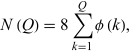
The number of polygon edges is
 |
(2)
|
where  is the totient function. The figure above shows
the cases
 ,
2, 4, and 8, with 8, 16, 48, and 176 polygon edges,
respectively.

Translate each lattice polygon so that the arithmetic mean of its polygon vertices is at the origin, then divide their coordinates by the largest Euclidean norm of a polygon vertex. The normalized square-cutoff family approaches a closed curve consisting of an arc of the parabola
 |
(3)
|
for  and its three quarter-turn rotations (Martin 2003).
The left-hand panel shows the normalized cases
 , 2, 4, 8, and 16 in blue and the limit
in dashed orange.
Jarník's (1926) original construction instead selects the vectors satisfying 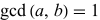 and
 .
These give a convex lattice
polygon of least perimeter among those in
 with the same number of polygon
edges. Under the same centering and scaling, this disk-cutoff family approaches
the unit circle (Žunić 2003), as illustrated
in the right-hand panel. The distinction between the two cutoffs is explicitly discussed
by Žunić (2017).
