


An integral drawing of a graph, not to be confused with an integral graph, places its vertices at distinct points and draws its graph edges with integer lengths. The length condition does not require the edges to be disjoint, while an integral embedding additionally requires the edges to meet only at common endpoints. Every graph possesses an integral drawing (Müller 1953, Harborth and Möller 1994).
It is conjectured that every planar graph has an integral drawing that is also a planar graph embedding.
A unit-distance embedding is the special case in which every graph edge has the same length, normalized to 1, and a graph that possesses one is called a unit-distance graph. Unit-distance embeddings therefore minimize the largest edge length among integral drawings.
The following table summarizes the minimum diameters for integral and plane integral drawings of the Platonic graphs (Müller 1953,
Harborth et al. 1987, Harborth and Möller 1994), where  refers to the "diameter" given by the largest
integer in the set of lengths of an integral drawing (not the graph
diameter).
refers to the "diameter" given by the largest
integer in the set of lengths of an integral drawing (not the graph
diameter).
| graph |  |  plane plane |
| cubical graph | 1 | 2 |
| dodecahedral graph | 1 | 2 |
| icosahedral graph | 8 | 159 |
| octahedral graph | 7 | 13 |
| tetrahedral graph | 4 | 17 |
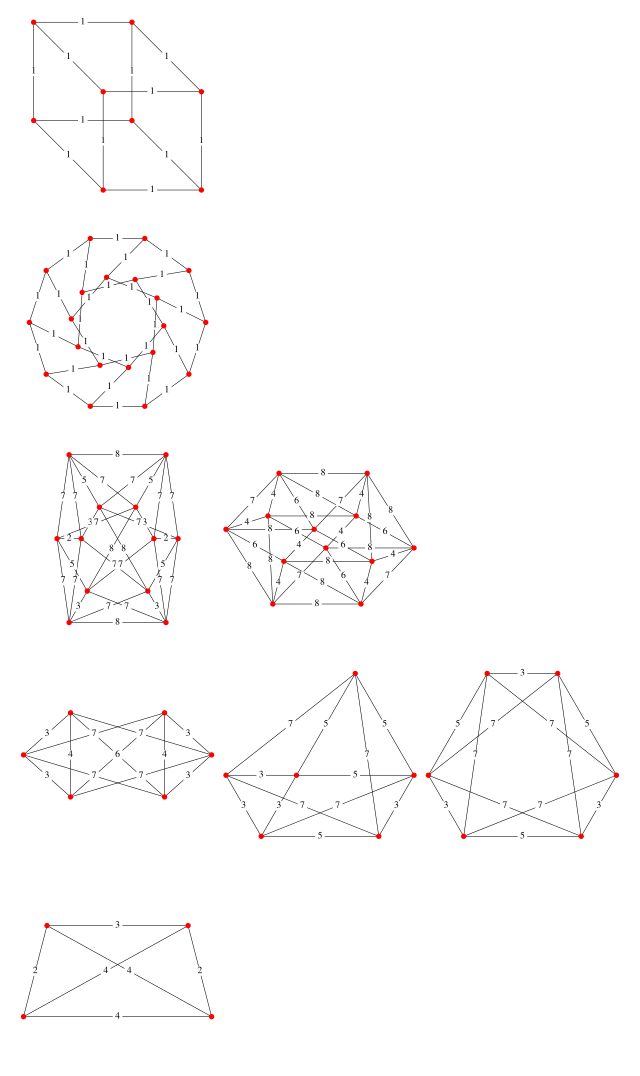
The minimal integral drawings of the Platonic graphs are illustrated above (Harborth and Möller 1994).
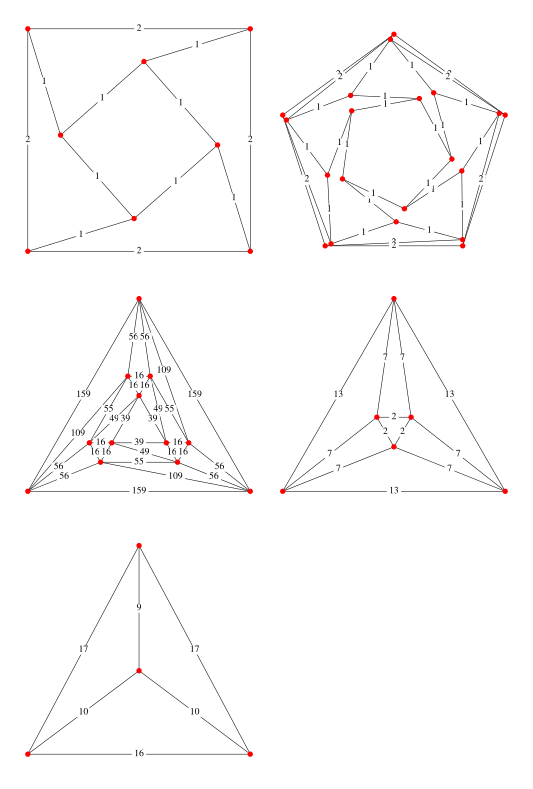
The minimal planar integral drawings of the Platonic graphs are illustrated above (Harborth et al. 1987).
