

The Gauss-Codazzi equations are compatibility equations relating the first fundamental
form and second fundamental form of
a regular surface in  .
.
Writing  for the shape operator,
  for the Gaussian curvature,
and
for the Gaussian curvature,
and  for the Levi-Civita connection, the equations
can be written
for the Levi-Civita connection, the equations
can be written
 |  |  |
(1)
|
 |  |  |
(2)
|
The first relation,  , is the Gauss equation, while the second represents the
Peterson-Mainardi-Codazzi equations.
The Gauss equation states that the intrinsic curvature
computed from the first fundamental form
agrees with the determinant of the shape operator
imposed by the second fundamental form.
It is therefore a form of Gauss's theorema
egregium. The Codazzi equations state that the covariant
derivative of the shape operator is symmetric.
, is the Gauss equation, while the second represents the
Peterson-Mainardi-Codazzi equations.
The Gauss equation states that the intrinsic curvature
computed from the first fundamental form
agrees with the determinant of the shape operator
imposed by the second fundamental form.
It is therefore a form of Gauss's theorema
egregium. The Codazzi equations state that the covariant
derivative of the shape operator is symmetric.
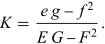
In local coordinates, write the fundamental forms as  and
and  . The Gauss equation then gives
 |
(3)
|
For example, on the unit sphere,  is plus or minus the identity
operator, so
is plus or minus the identity
operator, so  and
and  , and both equations are satisfied.
Conversely, sufficiently smooth forms  and
and  on a simply connected
domain, with
on a simply connected
domain, with  positive definite, that satisfy the Gauss-Codazzi equations determine an immersion
into
positive definite, that satisfy the Gauss-Codazzi equations determine an immersion
into  ,
unique up to a rigid motion. This result is the fundamental theorem of surface theory
(Ciarlet 2003, Mardare 2004).
,
unique up to a rigid motion. This result is the fundamental theorem of surface theory
(Ciarlet 2003, Mardare 2004).
For a surface with constant Gaussian curvature  ,
a suitable choice of asymptotic coordinates and orientation reduces the Gauss-Codazzi
equations to the sine-Gordon equation
,
a suitable choice of asymptotic coordinates and orientation reduces the Gauss-Codazzi
equations to the sine-Gordon equation
 |
(4)
|
Breather solutions of this equation produce breather surfaces (Terng and Uhlenbeck 2000).
