


A breather surface is a surface obtained from a breather solution of the sine-Gordon equation. At
points where its coordinate map satisfies the regular
parameterization condition, meaning that the two coordinate tangent
vectors are linearly independent, it
has constant Gaussian curvature  .
.
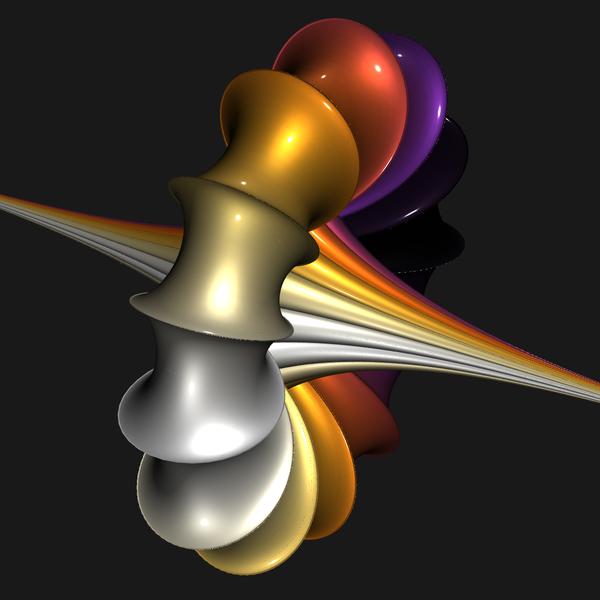
The image above shows one full period in  of the breather surface for
 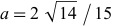 , with
  and
and  (Bryant 2026). The two long, curved-sided spikes
are the tapering ends of the surface. As
(Bryant 2026). The two long, curved-sided spikes
are the tapering ends of the surface. As  increases,
  and
and  tend to 0, causing the colored sheets to crowd toward the
x-axis. Along the middle, periodic variation in
tend to 0, causing the colored sheets to crowd toward the
x-axis. Along the middle, periodic variation in
 produces a spring-like sequence of lobes
that narrow to necks and flare outward. The apparent stack of tubes consists of overlapping
folds of the same parametrized surface, and the cyclic colors make those folds easier
to follow.
produces a spring-like sequence of lobes
that narrow to necks and flare outward. The apparent stack of tubes consists of overlapping
folds of the same parametrized surface, and the cyclic colors make those folds easier
to follow.
The construction uses the Gauss-Codazzi equations for a surface of Gaussian curvature  , which reduce to the sine-Gordon
equation in suitable asymptotic coordinates. The fundamental
theorem of surface theory then shows that a solution locally determines a surface
in
, which reduce to the sine-Gordon
equation in suitable asymptotic coordinates. The fundamental
theorem of surface theory then shows that a solution locally determines a surface
in  up to a rigid motion. In particular, the breather
solutions give a one-parameter family of breather surfaces (Terng and Uhlenbeck 2000;
Popov 2014, pp. 168-174).
up to a rigid motion. In particular, the breather
solutions give a one-parameter family of breather surfaces (Terng and Uhlenbeck 2000;
Popov 2014, pp. 168-174).
For  ,
set
,
set  .
A surface corresponding to the associated breather solution
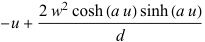
has the parametric equations
.
A surface corresponding to the associated breather solution
has the parametric equations
 |  |  |
(1)
|
 |  |  |
(2)
|
 |  |  |
(3)
|
where  is the auxiliary common denominator
![d=a{[wcosh(au)]^2+[asin(wv)]^2}.](/images/equations/BreatherSurface/NumberedEquation1.svg) |
(4)
|
Direct calculation gives the Gaussian curvature
 |
(5)
|
at every such point (Virtual Math Museum). The singular curves are the images of curves in the  -plane along which the two coordinate tangent
vectors become linearly dependent. Their occurrence is consistent with Hilbert's
theorem on regular surfaces, which rules out a complete regular
surface of constant negative Gaussian curvature
in
-plane along which the two coordinate tangent
vectors become linearly dependent. Their occurrence is consistent with Hilbert's
theorem on regular surfaces, which rules out a complete regular
surface of constant negative Gaussian curvature
in  (Terng and Uhlenbeck 2000).
The parametric equations contain the two frequencies 1 and  , so the surface is periodic in
  when
when  is a rational number. For
example,
is a rational number. For
example, 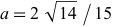 gives
gives  and period
  .
As
.
As  ,
the family approaches the Kuen surface up to a rigid motion (Virtual Math Museum).
,
the family approaches the Kuen surface up to a rigid motion (Virtual Math Museum).
