

The finite 2-adic complexity of a finite binary sequence measures the minimum size of a rational number
representing its digits modulo a power
of 2. For a string of  bits
 ,
 , ...,
 , let
 |
(1)
|
Thus  is the least significant bit. Define the
rational complexity
 |
(2)
|
where the minimum is over integers  and
 with
 positive and odd. The finite 2-adic complexity is then the binary
logarithm
 |
(3)
|
This convention uses the unrounded logarithm. The odd denominator makes
 a p-adic integer for
 , and the congruence fixes
its first
 binary digits (Lin et al. 2026).
For example, when
 , the residues 0, 1, 2, and 3 have respective values
 of 1, 1, 2, and 1.
Lin et al. (2026, Question 3.1) asked about the mean and variance of this complexity for uniformly chosen strings. With
each  in
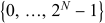 equally likely, the expectation value is
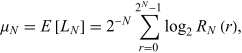 |
(4)
|
and the variance is
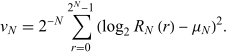 |
(5)
|
For example,  and
 .
Babanskyy (2026) reported exact finite distribution formulas and the bound
 |
(6)
|
for every  ,
together with the asymptotic formula
 |
(7)
|
where  is as in little-O notation,
 is the Riemann zeta
function, and
 is the natural logarithm.
The reported limiting variance is
 |
(8)
|
The author reports assistance from OpenAI Codex and GPT-6.1 Sol. As of Oct. 5, 2026, finite certificate checks for  through 14 had been reproduced, but independent specialist
review of the arguments for all
 and the limiting variance had
not been reported. No Lean formalization was supplied (Babanskyy 2026, VibeMathed
2026).
