TOPICS
Search

Egg


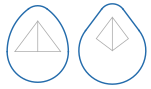
A planar "egg" is an oval with one end more pointed than the other. An ellipse is also an oval, but its two ends have the same shape, so it is not a planar egg.

The following table compares five named examples. Thom (1967, pp. 29-30) describes the stone-ring models, Dixon (1991, pp. 5 and 11) illustrates Moss's egg and Cundy and Rollett's egg, and Dumoutier (2021) describes the pentagon egg.

illustrationnamedescription
EggTableBurleigh
Burleigh's ovalnegative pedal curve of an ellipse of eccentricity 1/3 with respect to a focus
EggTableCundy
Cundy and Rollett's eggfour tangent circular arcs forming the outline of a twelve-piece puzzle
EggTableMoss
Moss's eggoval formed by four tangent circular arcs
EggTablePentagon
pentagon eggoval formed by four tangent circular arcs from a regular pentagon
EggTableThom
Thom's eggsstone-ring models using circular arcs and, in Type II, straight segments

In three dimensions, rotating a symmetric egg-shaped profile about its axis of symmetry gives an egg-shaped surface of revolution. A related solid of revolution is the superegg, obtained by rotating a superellipse about a coordinate axis.

EggFabergeHen

The white enamel shell of Fabergé's 1885 Hen Egg gives a physical example of an egg-shaped profile (Fabergé Museum). The simplified outline follows the shell in the cropped photograph by Ovchinnikov (2013), with the more pointed end at left.

EggFabergeRoseTrellis
EggFabergeGatchinaPalace
Rose Trellis Egg (1907)Gatchina Palace Egg (1901)

Two decorated Fabergé eggs show how different patterns follow the curved shells. The Rose Trellis Egg has a trellis set with diamonds, and the Gatchina Palace Egg has bands of pearls.

Vegreville Pysanka in Alberta, Canada

The Vegreville Pysanka, a giant Easter egg in Alberta, Canada, approximates an egg-shaped surface of revolution with a faceted shell of equilateral triangles and three-pointed stars (Easton 2005, McDermott 2005). The photograph is by Striatic (2007).

TrottEasterEggs

Trott (2004, pp. 772-785) constructs colored Easter eggs by recursively subdividing the triangular faces of an icosahedron, projecting the resulting vertices radially onto a unit sphere, and deforming the unit sphere into an egg shape. The deformation preserves the height z and, away from the poles, the azimuthal angle. It changes the distance from the vertical axis to 0.7(1+z)^(1/3)(1-z)^(1/2) for -1<=z<=1, leaving both poles fixed.


See also

Cundy and Rollett's Egg, Ellipse, Moss's Egg, Oval, Ovoid, Pentagon Egg, Regular Pentagon, Superegg, Superellipse, Superellipsoid, Thom's Eggs

Explore with Wolfram|Alpha

References

Dixon, R. Mathographics. New York: Dover, pp. 5-6 and 11, 1991.Dumoutier, C. "Géométrie : L'œuf du pentagone." Art et Tonneaux. May 6, 2021. https://art-et-tonneaux.fr/blog/video-geometrie-baignoire-ove-pentagone-n81.Easton, J. "The World's Largest Easter Egg." Tabloid Column. March 26, 2005. https://web.archive.org/web/20050403154642/http://www.tabloidcolumn.com/easter-egg.html.Fabergé Museum. "Hen Easter Egg." https://fabergemuseum.ru/en/collections/collection-highlights/hen-easter-egg.McDermott, R. "A Ukrainian Easter Egg Monument Stands for Thirty Years." In Renaissance Banff: Mathematics, Music, Art, Culture (Ed. R. Sarhangi and R. V. Moody). Winfield, KS: Bridges Conference, pp. 109-116, 2005. https://archive.bridgesmathart.org/2005/bridges2005-109.pdf.Ovchinnikov, M. "Hen Egg." Photograph, Sep. 16, 2013. https://commons.wikimedia.org/wiki/File:%D0%AF%D0%B9%D1%86%D0%BE_%22%D0%9A%D1%83%D1%80%D0%BE%D1%87%D0%BA%D0%B0%22_(cropped).JPG. Photograph and outline licensed under CC BY-SA 4.0, https://creativecommons.org/licenses/by-sa/4.0/.Striatic. "Vegreville Egg--World's Largest Pysanka." Photograph, June 9, 2007. https://commons.wikimedia.org/wiki/File:Vegreville_egg_large.jpg. CC BY 2.0, https://creativecommons.org/licenses/by/2.0/.Thom, A. "Mathematical Background." Ch. 4 in Megalithic Sites in Britain. Oxford, England: Oxford University Press, pp. 27-33, 1967.Trott, M. The Mathematica GuideBook for Graphics. New York: Springer-Verlag, pp. 772-785, 2004. https://doi.org/10.1007/978-1-4419-8576-7.Walters Art Museum. "Gatchina Palace Egg." Collection 44.500. https://art.thewalters.org/object/44.500/. Photograph, https://commons.wikimedia.org/wiki/File:House_of_Faberg%C3%A9_-_Gatchina_Palace_Egg_-_Walters_44500_-_Closed.jpg. CC BY-SA 3.0, https://creativecommons.org/licenses/by-sa/3.0/.Walters Art Museum. "Rose Trellis Egg." Collection 44.501. https://art.thewalters.org/object/44.501/. Cropped photograph, https://commons.wikimedia.org/wiki/File:House_of_Faberg%C3%A9_-_Rose_Trellis_Egg_-_Walters_44501.jpg. CC BY-SA 3.0, https://creativecommons.org/licenses/by-sa/3.0/.

Referenced on Wolfram|Alpha

Egg

Cite this as:

Weisstein, Eric W. "Egg." From MathWorld--A Wolfram Resource. https://mathworld.wolfram.com/Egg.html

Subject classifications