


Thom's eggs are egg-shaped curves constructed using multiple circles. Thom (1967) used them to model Megalithic stone rings in Britain.
In Type I, two circular arcs join a semicircle to a smaller circular arc at the pointed end. The centers of the two joining arcs lie on the line through the center of the semicircle and perpendicular to the axis of symmetry. Together with the two end centers, they form a pair of right triangles reflected across the axis of symmetry (Thom 1967, pp. 29-30).
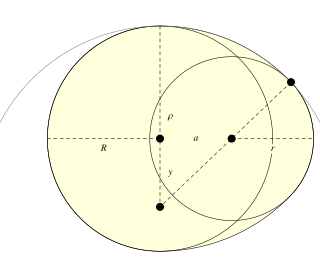
The Type I egg illustrated above can be constructed with a compass by joining together arcs of different radii
such that the centers of the arcs
lie on a line passing through the join point (Dixon 1991).
Albrecht Dürer used this method to design a Roman letter font. If the separation
between left and right caps is  and the radii are
 and
 , respectively, with
 and
 , then the center
 and radius
 of the joining circle
are
 |  |  |
(1)
|
 |  |  |
(2)
|
where  is a signed Cartesian
coordinate, rather than a positive distance. The
cap centers are
 and
 , and
 .
In the figure,  ,
 ,
and
 , giving
 . The two cap centers
and the center of the upper joining circular
arc therefore form a right triangle with side lengths in the ratio
 .
Its hypotenuse passes through the join with the smaller
cap.
Call the three circles  ,
 , and
 . Let the upper point of intersection of
 and
 be
 , let the angle
between the vertical dashed line and the line
through
 be
 , and let the angle between
the horizontal radius of
 and dashed line through
 be
 . Then
 |  |  |
(3)
|
 |  |  |
(4)
|
 |  |  |
(5)
|
 |  |  |
(6)
|
and half the area enclosed by the oval is the sum of the areas of the leftmost quarter-disk,
the circular sector of  ,
and the circular sector of
 minus the area of the triangular
portion of the circular sector of
 lying below the
 -axis, so
 |  |  |
(7)
|
 |  |  |
(8)
|
 |  |  |
(9)
|
As expected, this formula reduces to the area of a circle
 |
(10)
|
for  , and to the area of
a stadium
 |
(11)
|
for  .
