

The convex floating body of a convex body  is the intersection
of the closed half-spaces left after cutting off caps
of a prescribed volume from
 (Schütt and Werner 1990).
Write  for
 -dimensional
Lebesgue measure, and suppose
 and
 . For each
unit vector
 , let
 be the unique real
number such that
 ,
where
 is the Euclidean inner product and
 is the Euclidean l2-norm.
Then the convex floating body is
 |
Here  is an absolute cap volume, rather than a fraction of
 . If a relative parameter
 is used instead, the corresponding absolute parameter
is
 .
The intersection is a compact convex set contained in  , but it may be the empty set.
In particular, it need not itself be a convex body
with nonempty interior.
For a triangle of area
 , it is empty when
 . Indeed, cuts parallel
to the three sides require each of the normalized barycentric
coordinates to be at most
 , whereas
their sum is one. Increasing
 shrinks the retained half-spaces,
so
 when
 .
If  is an invertible affine transformation,
then
 , since every cap volume
is multiplied by
 , where
 is the determinant of
 . Thus the relative-volume parameter is unchanged by
invertible affine transformations.
For a planar disk of radius  , rotational symmetry
makes
 the concentric disk of radius
 , where
 is determined by the circular
segment area
 |
Here  denotes the inverse cosine. The equation
has a unique solution for
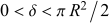 , because the cap area
decreases strictly from
 to zero as
 increases from zero to
 .
The intersection construction is distinct from requiring every supporting hyperplane of the resulting
set to cut off volume  from
 . The latter is the classical
floating-body condition and does not follow merely from the intersection
definition (Schütt and Werner 1990).
The Ulam floating body problem is a different question. It asks whether a homogeneous convex body that floats in equilibrium in every orientation must be a closed ball (Ryabogin 2022). Its equilibrium condition concerns the centroids of the submerged portions, rather than the intersection of retained half-spaces.
