The logarithmic derivative of a differentiable function
(1)
at points where branch of derivative
of that logarithm and is independent of the chosen
branch . For a nonzero differentiable real function of a real
variable , it is also the derivative of
Products and quotients therefore
satisfy
where the functions are differentiable
and nonzero.
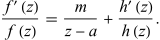
If a meromorphic function has a root or pole at integer and analytic with
(4)
Consequently,
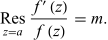
(5)
The complex residue is the multiplicity of a root or the negative order of a pole
(Orloff 2018, pp. 1-2). Integrating these complex
residues gives the argument principle .
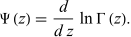
The digamma function is the logarithmic derivative
of the gamma function ,
(6)
See also Argument Principle ,
Complex Residue ,
Derivative ,
Digamma
Function ,
Logarithm ,
Pole ,
Polygamma Function
Explore with Wolfram|Alpha
References Liu, Z.-G. "Residue Theorem and Theta Function Identities." Ramanujan J. 5 , 129-151, 2001. https://doi.org/10.1023/A:1011427622187 . Orloff,
J. "Argument Principle." Topic 11 in Complex Variables with Applications.
Cambridge, MA: Massachusetts Institute of Technology, pp. 1-4, 2018. https://ocw.mit.edu/courses/18-04-complex-variables-with-applications-spring-2018/resources/mit18_04s18_topic11/ . Trott,
M. "Logarithmic Residue." Exercise and solution 41(c) in The
Mathematica GuideBook for Symbolics. https://doi.org/10.1007/0-387-28815-5 .
https://www.mathematicaguidebooks.org/ . Zwillinger,
D. (Ed.). "Logarithmic Derivative." §6.11.8 in CRC
Standard Mathematical Tables and Formulae. Referenced on Wolfram|Alpha Logarithmic Derivative
Cite this as:
Weisstein, Eric W. "Logarithmic Derivative."
From MathWorld https://mathworld.wolfram.com/LogarithmicDerivative.html
Subject classifications


 is

 . When a branch of
 is defined, this is the derivative
of that logarithm and is independent of the chosen
branch. For a nonzero differentiable real function of a real
variable, it is also the derivative of
 .


 , it can locally be written as
 , where
 is a nonzero integer and
 is analytic with
 . Its logarithmic derivative then has the form