


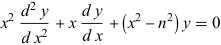
The Bessel functions of the first kind  are defined as the solutions to the Bessel
differential equation
are defined as the solutions to the Bessel
differential equation
 |
(1)
|
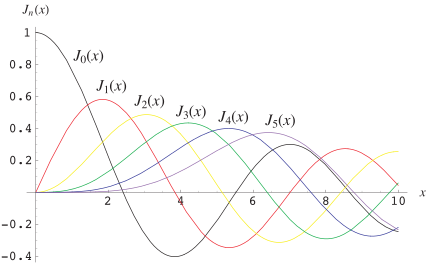
which are nonsingular at the origin. They are sometimes also called cylinder functions or cylindrical harmonics. The above plot shows  for
for  , 1, 2, ..., 5. The notation
  was first used by Hansen (1843) and subsequently by
Schlömilch (1857) to denote what is now written
was first used by Hansen (1843) and subsequently by
Schlömilch (1857) to denote what is now written  (Watson 1966, p. 14). However, Hansen's definition
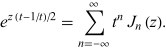
of the function itself in terms of the generating
function
(Watson 1966, p. 14). However, Hansen's definition
of the function itself in terms of the generating
function
 |
(2)
|
is the same as the modern one (Watson 1966, p. 14). Bessel used the notation  to denote what is now called the Bessel function of the first kind (Cajori 1993,
vol. 2, p. 279).
to denote what is now called the Bessel function of the first kind (Cajori 1993,
vol. 2, p. 279).
The Bessel function  can also be defined by the contour
integral
can also be defined by the contour
integral
 |
(3)
|
where the contour encloses the origin and is traversed in a counterclockwise direction (Arfken 1985, p. 416).
The Bessel function of the first kind is implemented in the Wolfram Language as BesselJ[nu, z].
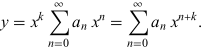
To solve the differential equation, apply Frobenius method using a series solution of the form
 |
(4)
|
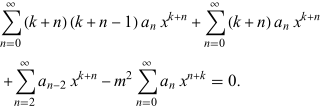
Plugging into (1) yields
 |
(5)
|
 |
(6)
|
The indicial equation, obtained by setting  ,
is
,
is
![a_0[k(k-1)+k-m^2]=a_0(k^2-m^2)=0.](/images/equations/BesselFunctionoftheFirstKind/NumberedEquation7.svg) |
(7)
|
Since  is defined as the first nonzero term,
  , so
, so  . Now, if
  ,
,
![sum_(n=0)^infty[(m+n)(m+n-1)+(m+n)-m^2]a_nx^(m+n)+sum_(n=2)^inftya_(n-2)x^(m+n)=0](/images/equations/BesselFunctionoftheFirstKind/NumberedEquation8.svg) |
(8)
|
![sum_(n=0)^infty[(m+n)^2-m^2]a_nx^(m+n)+sum_(n=2)^inftya_(n-2)x^(m+n)=0](/images/equations/BesselFunctionoftheFirstKind/NumberedEquation9.svg) |
(9)
|
 |
(10)
|
![a_1(2m+1)x^(m+1)+sum_(n=2)^infty[a_nn(2m+n)+a_(n-2)]x^(m+n)=0.](/images/equations/BesselFunctionoftheFirstKind/NumberedEquation11.svg) |
(11)
|
First, look at the special case  , then (11) becomes
![sum_(n=2)^infty[a_nn(n-1)+a_(n-2)]x^(m+n)=0,](/images/equations/BesselFunctionoftheFirstKind/NumberedEquation12.svg) |
(12)
|
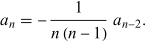
so
 |
(13)
|
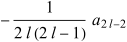
Now let  ,
where
,
where  ,
2, ....
,
2, ....
 |  |  |
(14)
|
 |  | ![((-1)^l)/([2l(2l-1)][2(l-1)(2l-3)]...[2·1·1])a_0](/images/equations/BesselFunctionoftheFirstKind/Inline21.svg) |
(15)
|
 |  |  |
(16)
|
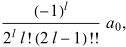
which, using the identity  , gives
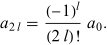 |
(17)
|
Similarly, letting  ,
,
![a_(2l+1)=-1/((2l+1)(2l))a_(2l-1)=((-1)^l)/([2l(2l+1)][2(l-1)(2l-1)]...[2·1·3][1])a_1,](/images/equations/BesselFunctionoftheFirstKind/NumberedEquation15.svg) |
(18)
|
which, using the identity  , gives
 |
(19)
|
Plugging back into (4) with 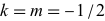 gives
gives
 |  |  |
(20)
|
 |  | ![x^(-1/2)[sum_(n=1,3,5,...)^(infty)a_nx^n+sum_(n=0,2,4,...)^(infty)a_nx^n]](/images/equations/BesselFunctionoftheFirstKind/Inline34.svg) |
(21)
|
 |  | ![x^(-1/2)[sum_(l=0)^(infty)a_(2l)x^(2l)+sum_(l=0)^(infty)a_(2l+1)x^(2l+1)]](/images/equations/BesselFunctionoftheFirstKind/Inline37.svg) |
(22)
|
 |  | ![x^(-1/2)[a_0sum_(l=0)^(infty)((-1)^l)/((2l)!)x^(2l)+a_1sum_(l=0)^(infty)((-1)^l)/((2l+1)!)x^(2l+1)]](/images/equations/BesselFunctionoftheFirstKind/Inline40.svg) |
(23)
|
 |  |  |
(24)
|
The Bessel functions of order  are therefore defined as
 |  |  |
(25)
|
 |  |  |
(26)
|
so the general solution for  is
is
 |
(27)
|
Now, consider a general  . Equation (11) requires
 |
(28)
|
![[a_nn(2m+n)+a_(n-2)]x^(m+n)=0](/images/equations/BesselFunctionoftheFirstKind/NumberedEquation19.svg) |
(29)
|
for  ,
3, ..., so
,
3, ..., so
 |  |  |
(30)
|
 |  | 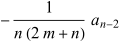 |
(31)
|
for  ,
3, .... Let
,
3, .... Let  , where
  , 2, ..., then
 |  | ![-1/((2l+1)[2(m+l)+1])a_(2l-1)](/images/equations/BesselFunctionoftheFirstKind/Inline65.svg) |
(32)
|
 |  |  |
(33)
|
where  is the function of
  and
and  obtained by iterating the recursion relationship down to
  .
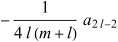
Now let
.
Now let  ,
where
,
where  ,
2, ..., so
,
2, ..., so
 |  | 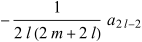 |
(34)
|
 |  |  |
(35)
|
 |  | ![((-1)^l)/([4l(m+l)][4(l-1)(m+l-1)]...[4·(m+1)])a_0.](/images/equations/BesselFunctionoftheFirstKind/Inline83.svg) |
(36)
|
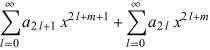
Plugging back into (4),
 |  |  |
(37)
|
 |  |  |
(38)
|
 |  | ![a_0sum_(l=0)^(infty)((-1)^l)/([4l(m+l)][4(l-1)(m+l-1)]...[4(m+1)])x^(2l+m)](/images/equations/BesselFunctionoftheFirstKind/Inline92.svg) |
(39)
|
 |  | ![a_0sum_(l=0)^(infty)([(-1)^lm(m-1)...1]x^(2l+m))/([4l(m+l)][4(l-1)(m+l-1)]...[4(m+1)m...1])](/images/equations/BesselFunctionoftheFirstKind/Inline95.svg) |
(40)
|
 |  |  |
(41)
|
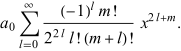
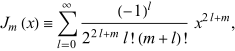
Now define
 |
(42)
|
where the factorials can be generalized to gamma functions for nonintegral  . The above equation then becomes
 |
(43)
|
Returning to equation (7) and examining the case  ,
,
![a_1(1-2m)+sum_(n=2)^infty[a_nn(n-2m)+a_(n-2)]x^(n-m)=0.](/images/equations/BesselFunctionoftheFirstKind/NumberedEquation22.svg) |
(44)
|
However, the sign of  is arbitrary, so the solutions must be the same for
  and
and  . We are therefore free to replace
  with
with  , so
, so
![a_1(1+2|m|)+sum_(n=2)^infty[a_nn(n+2|m|)+a_(n-2)]x^(|m|+n)=0,](/images/equations/BesselFunctionoftheFirstKind/NumberedEquation23.svg) |
(45)
|
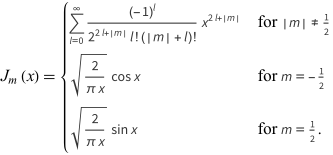
and we obtain the same solutions as before, but with  replaced by
  .
.
 |
(46)
|
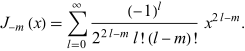
We can relate  and
and  (when
(when  is an integer) by writing
 |
(47)
|
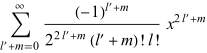
Now let  .
Then
.
Then
 |  |  |
(48)
|
 |  |  |
(49)
|
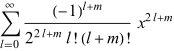
But  for
for  ,
so the denominator is infinite and the terms on the
left are zero. We therefore have
,
so the denominator is infinite and the terms on the
left are zero. We therefore have
 |  |  |
(50)
|
 |  |  |
(51)
|
Note that the Bessel differential equation is second-order, so
there must be two linearly independent solutions. We have found both only for  .
For a general nonintegral order, the independent solutions are
.
For a general nonintegral order, the independent solutions are  and
and  . When
  is an integer, the general (real)
solution is of the form
is an integer, the general (real)
solution is of the form
 |
(52)
|
where  is a Bessel function of the first kind,
  (a.k.a.
  ) is the Bessel
function of the second kind (a.k.a. Neumann function or Weber function), and
) is the Bessel
function of the second kind (a.k.a. Neumann function or Weber function), and
 and
and  are constants. Complex solutions are given by the Hankel
functions (a.k.a. Bessel functions of the third kind).
are constants. Complex solutions are given by the Hankel
functions (a.k.a. Bessel functions of the third kind).
The Bessel functions are orthogonal in ![[0,a]](/images/equations/BesselFunctionoftheFirstKind/Inline135.svg) according to
according to
![int_0^aJ_nu(alpha_(num)rho/a)J_nu(alpha_(nun)rho/a)rhodrho=1/2a^2[J_(nu+1)(alpha_(num))]^2delta_(mn),](/images/equations/BesselFunctionoftheFirstKind/NumberedEquation27.svg) |
(53)
|
where  is the
  th
zero of
th
zero of  and
and  is the Kronecker delta (Arfken 1985, p. 592).
Except when  is a negative integer,
 |
(54)
|
where  is the gamma function and
  is a Whittaker function.
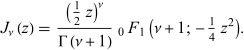
In terms of a confluent hypergeometric function of the first kind, the Bessel function is written
 |
(55)
|
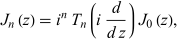
A derivative identity for expressing higher order Bessel functions in terms of  is
is
 |
(56)
|
where  is a Chebyshev polynomial of the
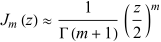
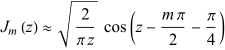
first kind. Asymptotic forms for the Bessel functions are
is a Chebyshev polynomial of the
first kind. Asymptotic forms for the Bessel functions are
 |
(57)
|
for  and
and
 |
(58)
|
for 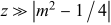 (correcting the condition of Abramowitz and Stegun 1972, p. 364).
A derivative identity is
![d/(dx)[x^mJ_m(x)]=x^mJ_(m-1)(x).](/images/equations/BesselFunctionoftheFirstKind/NumberedEquation33.svg) |
(59)
|
An integral identity is
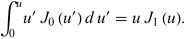 |
(60)
|
Some sum identities are
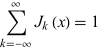 |
(61)
|
(which follows from the generating function (2) with  ),
),
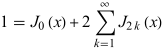
![1=[J_0(x)]^2+2sum_(k=1)^infty[J_k(x)]^2](/images/equations/BesselFunctionoftheFirstKind/NumberedEquation36.svg) |
(62)
|
(Abramowitz and Stegun 1972, p. 363),
 |
(63)
|
(Abramowitz and Stegun 1972, p. 361),
 |
(64)
|
for  (Abramowitz and Stegun 1972, p. 361),
 |
(65)
|
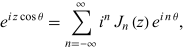
(Abramowitz and Stegun 1972, p. 361), and the Jacobi-Anger expansion
 |
(66)
|
which can also be written
 |
(67)
|
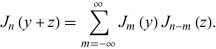
The Bessel function addition theorem states
 |
(68)
|
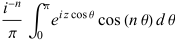
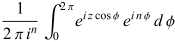
Various integrals can be expressed in terms of Bessel functions
 |
(69)
|
which is Bessel's first integral,
 |  |  |
(70)
|
 |  |  |
(71)
|
for  ,
2, ...,
,
2, ...,
 |
(72)
|
for  ,
2, ...,
,
2, ...,
 |
(73)
|
for  .
The Bessel functions are normalized so that
.
The Bessel functions are normalized so that
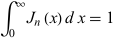 |
(74)
|
for positive integral (and real)  . Integrals involving
  include
![int_0^infty[(J_1(x))/x]^2dx=4/(3pi)](/images/equations/BesselFunctionoftheFirstKind/NumberedEquation47.svg) |
(75)
|
![int_0^infty[(J_1(x))/x]^2xdx=1/2.](/images/equations/BesselFunctionoftheFirstKind/NumberedEquation48.svg) |
(76)
|
Ratios of Bessel functions of the first kind have continued fraction
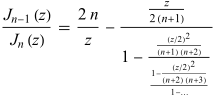 |
(77)
|
(Wall 1948, p. 349).
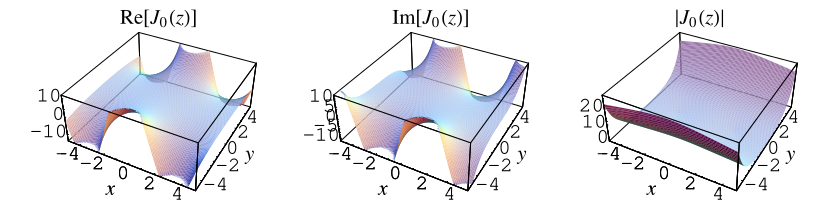
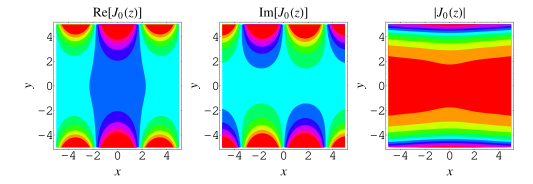
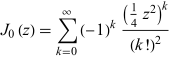
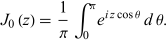
The special case of  gives
gives  as the series
 |
(78)
|
(Abramowitz and Stegun 1972, p. 360), or the integral
 |
(79)
|

 and
and  ." §9.1 in
  " and "Orthogonality." §11.1 and
11.2 in
" and "Orthogonality." §11.1 and
11.2 in  and
and  " and "The Bessel Function
  ." Chs. 52-53 in