A Calogero-Sutherland model is an exactly solvable many-variable eigenvalue problem for a Schrödinger operator
with singular pair interactions. The rational model with harmonic confinement has
quantum Hamiltonian
(1)
where ground
state and its eigenvalue are
Put eigenfunctions is
(4)
where Hermite polynomial , associated
Laguerre polynomial , nonnegative integers .
These satisfy
(5)
Illustrated above are the signed eigenfunctions for
so zeros of the common prefactor, and the radial zeros
of the associated Laguerre polynomial
give the nodal circles .
The case eigenfunctions have multivariate
Hermite polynomials as polynomial factors (Gonera
et al. 1999, Desrosiers et al. 2003).
The trigonometric model on a circle is also called the
Sutherland model. In angular coordinates, one normalization is
(8)
With eigenfunctions is
(9)
where Jack polynomial in the monic
normalization and partition with at most
eigenvalues are
(10)
This connects the integrable system to the differential equation for Jack
polynomials (Lapointe and Vinet 1996).
See also Associated Laguerre Polynomial ,
Calogero-Moser System ,
Hermite Polynomial ,
Integrable
System ,
Jack Polynomial ,
Multivariate
Hermite Polynomial ,
Schrödinger Operator
Explore with Wolfram|Alpha
References Calogero, F. "Solution of the One-Dimensional J. Math.
Phys. 12 , 419-436, 1971. https://doi.org/10.1063/1.1665604 . Desrosiers,
P.; Lapointe, L.; and Mathieu, P. "Generalized Hermite Polynomials in Superspace
as Eigenfunctions of the Supersymmetric Rational CMS Model." Nucl. Phys.
B 674 , 615-633, 2003. https://doi.org/10.1016/j.nuclphysb.2003.08.003 . Gonera,
C.; Kosiński, P.; Majewski, M.; and Maślanka, P. "On Calogero Wave
Functions." Acta Phys. Polon. B 30 , 915, 1999. https://arxiv.org/abs/solv-int/9812004 . Gurappa,
N.; Panigrahi, P. K.; and Raju, T. S. "A Unified Algebraic Approach
to Few and Many-Body Hamiltonians Having Linear Spectra." 9 Jan 1999. https://arxiv.org/abs/cond-mat/9901073 . Lapointe,
L. and Vinet, L. "Exact Operator Solution of the Calogero-Sutherland Model."
Comm. Math. Phys. 178 , 425-452, 1996. https://doi.org/10.1007/BF02099456 .
https://arxiv.org/abs/q-alg/9509003 . Song,
D.-Y. and Park, J. "Coherent States and Geometric Phases in Calogero-Sutherland
Model." Int. J. Mod. Phys. A 17 , 259-268, 2002. https://doi.org/10.1142/S0217751X0200561X .
https://arxiv.org/abs/quant-ph/0109108 . Sutherland,
B. "Exact Results for a Quantum Many-Body Problem in One Dimension." Phys.
Rev. A 4 , 2019-2021, 1971. https://doi.org/10.1103/PhysRevA.4.2019 . Sutherland,
B. "Exact Results for a Quantum Many-Body Problem in One Dimension. II."
Phys. Rev. A 5 , 1372-1376, 1972. https://doi.org/10.1103/PhysRevA.5.1372 . Trott,
M. "Relationships Among the Orthogonal Polynomials." §2.9 in The
Mathematica GuideBook for Symbolics. https://doi.org/10.1007/0-387-28815-5 .
https://www.mathematicaguidebooks.org/ .
Cite this as:
Weisstein, Eric W. "Calogero-Sutherland Model."
From MathWorld https://mathworld.wolfram.com/Calogero-SutherlandModel.html
Subject classifications



 and
 .
For
 on the region
 ,
choose the collision behavior proportional to
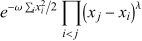
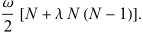
 . The unnormalized ground
state and its eigenvalue are




 and
 .
A family of eigenfunctions is

 is a Hermite polynomial,
 is an associated
Laguerre polynomial,
 , and
 and
 are nonnegative integers.
These satisfy

 ,
 ,
 ,
 ,
and
 ,
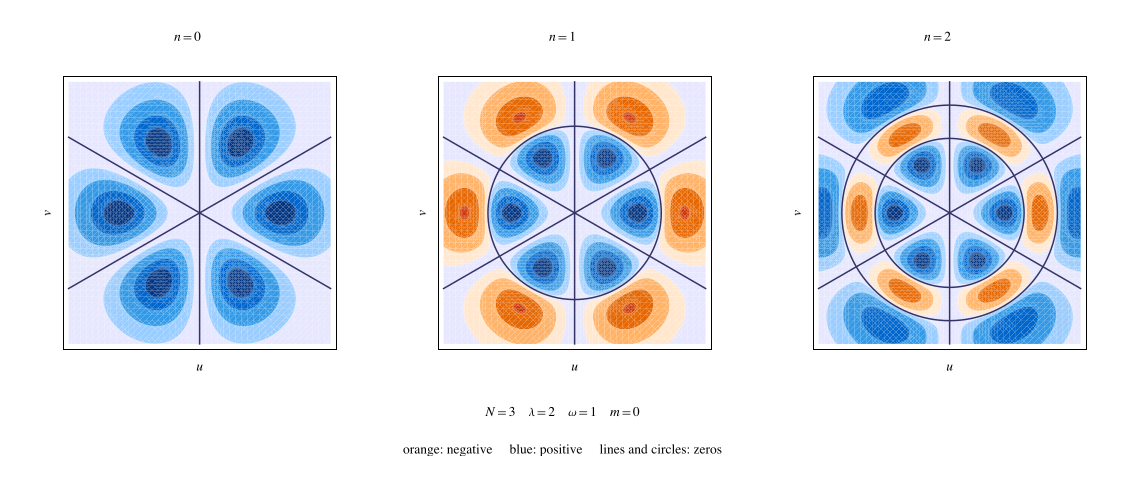
1, and 2, restricted to
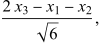
 and scaled independently for display. The relative coordinates
are


 .
Blue and orange indicate positive and negative values. The three collision lines
 and
 are zeros of the common prefactor, and the radial zeros
of the associated Laguerre polynomial
give the nodal circles.
 is the Hermite-Laguerre example in Trott (2006), following Song and Park (2002).
More general eigenfunctions have multivariate
Hermite polynomials as polynomial factors (Gonera
et al. 1999, Desrosiers et al. 2003).

 ,
 ,
and
 ,
a family of eigenfunctions is

 is a Jack polynomial in the monic
normalization and
 is a partition with at most
 parts. Their eigenvalues are


 -Body
Problems with Quadratic and/or Inversely Quadratic Pair Potentials." J. Math.
Phys. 12, 419-436, 1971.