


A partition is a way of writing a nonnegative integer  as a sum of positive integers
where the order of the addends is not significant, possibly
subject to one or more additional constraints. The empty partition is the unique
partition of 0. By convention, partitions are normally written from largest to smallest
addends (Skiena 1990, p. 51), for example,
as a sum of positive integers
where the order of the addends is not significant, possibly
subject to one or more additional constraints. The empty partition is the unique
partition of 0. By convention, partitions are normally written from largest to smallest
addends (Skiena 1990, p. 51), for example,  . All the partitions of a given positive
integer
. All the partitions of a given positive
integer  can be generated in the Wolfram Language
using IntegerPartitions[n].
can be generated in the Wolfram Language
using IntegerPartitions[n].
Equivalently, in the terminology of the twelvefold way, the partitions of  into at most
  parts count the ways of distributing
  identical balls into
  identical boxes.
Andrews (1998, p. 1) uses the notation 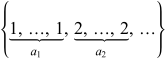 to indicate "a sequence
  is a partition of
 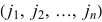 ," and the notation
  , known as the frequency
representation, to abbreviate the partition
, known as the frequency
representation, to abbreviate the partition  .
.
For a positive integer  , its partitions correspond to the set
of solutions
, its partitions correspond to the set
of solutions  in nonnegative integers to the Diophantine
equation
in nonnegative integers to the Diophantine
equation
 |
For example, the partitions of four, given by (1, 1, 1, 1), (1, 1, 2), (2, 2), (4), and (1, 3) correspond to the solutions  , (2, 1, 0, 0), (0, 2, 0, 0), (0,
0, 0, 1), and (1, 0, 1, 0).
, (2, 1, 0, 0), (0, 2, 0, 0), (0,
0, 0, 1), and (1, 0, 1, 0).
Particular types of partition functions include the partition function P, giving the number of partitions of  as a sum of positive
integers without regard to order, and partition
function Q, giving the number of ways of writing the integer
as a sum of positive
integers without regard to order, and partition
function Q, giving the number of ways of writing the integer  as a sum of positive integers without regard to order and with
the constraint that all integers in each sum
are distinct. The partition function bk,
which gives the number of partitions of
as a sum of positive integers without regard to order and with
the constraint that all integers in each sum
are distinct. The partition function bk,
which gives the number of partitions of  in which no parts are multiples of
  , is sometimes also used (Gordon and Ono 1997).
The Euler transform  gives the number of partitions of
  into integer parts of which there
are
into integer parts of which there
are  different types of parts of size 1,
 of size 2, etc. For example, if
  for all
  , then
  is the number of partitions of
  into integer parts. Similarly,
if
into integer parts. Similarly,
if  for
for  prime and
  otherwise, then
  is the number of partitions of
  into prime parts (Sloane and
Plouffe 1995, p. 21).
into prime parts (Sloane and
Plouffe 1995, p. 21).
A greedy algorithm that repeatedly chooses the largest allowed part need not find a partition, even when one exists. For example,
with  and the list
  , choosing 4 leaves an unrepresentable
remainder of 2, although
, choosing 4 leaves an unrepresentable
remainder of 2, although  is a valid partition. Partitions with parts in
  can be enumerated in the Wolfram
Language using IntegerPartitions[n,
All, L]. The following table gives the number of partitions of
can be enumerated in the Wolfram
Language using IntegerPartitions[n,
All, L]. The following table gives the number of partitions of  into positive integer
  th powers.
 |  |  |  |  |
| Sloane | A000041 | A001156 | A003108 | A046042 |
| 10 | 42 | 4 | 2 | 1 |
| 50 | 204226 | 104 | 10 | 4 |
| 100 | 190569292 | 1116 | 39 | 9 |
| 150 | 40853235313 | 6521 | 97 | 15 |
| 200 | 3972999029388 | 27482 | 208 | 24 |
| 250 | 230793554364681 | 94987 | 388 | 34 |
| 300 | 9253082936723602 | 284316 | 683 | 49 |
Partitions can also be counted by their number of parts. If  is the number of partitions of
  into exactly
  parts, then
  is a unimodal
sequence for every
is a unimodal
sequence for every  .
Padhi (2026) proved this Auluck-Chowla-Gupta
conjecture, completing the previously asymptotic result. Padhi (2026) reports
Claude assistance with computations and code.
.
Padhi (2026) proved this Auluck-Chowla-Gupta
conjecture, completing the previously asymptotic result. Padhi (2026) reports
Claude assistance with computations and code.
Another statistic of partitions is the smallest parts function, which counts the occurrences of their smallest parts with multiplicity. Rolen (2026) classified its canonical prime congruences, showing that the only primes are 5, 7, and 13.
