


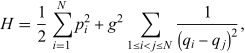
Calogero-Moser systems are integrable systems with singular pair interactions. The rational Calogero-Moser system is the Hamiltonian system defined by
 |
(1)
|
where  , the coordinates
 are distinct real numbers,
the momenta
 are real, and
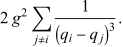
 . Hamilton's
equations give
 |  |  |
(2)
|
 |  |  |
(3)
|
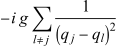
Its Lax pair can be written using matrices  and
 with entries
 |  |  |
(4)
|
 |  |  |
(5)
|
 |  |  |
(6)
|
 |  |  |
(7)
|
where the off-diagonal formulas apply for  and
 is the imaginary unit.
The evolution equation is
 |
(8)
|
so the eigenvalues of  are conserved. The matrix traces
 |
(9)
|
for  , ...,
 are integrals of motion
that commute under the Poisson bracket and are
functionally independent on a dense open
set. In particular,
 (Moser 1975; Etingof 2007, pp. 11-19).
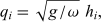
Adding the harmonic term  , where
 , gives equilibrium coordinates
 |
(10)
|
where the  are the zeros of the Hermite
polynomial
 with leading coefficient
 (Odake and Sasaki 2002). The quantum rational model with
harmonic confinement is a Calogero-Sutherland
model.

The equilibrium coordinates for  and
 , 5, and 8 are illustrated above.
The blue curves are the Hermite polynomials
multiplied by
 and scaled independently for display. This positive factor preserves their zeros,
which are marked as the orange equilibrium positions.

 -Body Problems with Quadratic and/or
Inversely Quadratic Pair Potentials." J. Math. Phys. 12, 419-436,
1971.