

A Brenier map is a quadratic-cost optimal transport map that is the gradient of a convex
function used as a potential. For an absolutely
continuous source probability measure  on
 and a target probability
measure
 , both with finite second
moments, this map minimizes
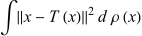 |
(1)
|
subject to  . It is unique up to a set
of
 -measure
zero and has the form
 for a convex function
 .
Let  be the uniform probability
measure on a fixed compact convex set
 with nonempty interior and
 .
For all target probability measures
 supported on a fixed nonempty compact set
 ,
OpenAI (2026) proved
 |
(2)
|
where  denotes the quadratic Wasserstein distance.
The exponent is sharp even for
 and three-atom targets. Toledo independently verified
the formalized stability and sharpness statements.
Let the source probability measure be  on
 ,
where
 is proper and lower semicontinuous,
 is a convex
function,
 , and
 . The function
 may be nonsmooth or take the value
 outside a convex domain.
For target probability measures
 and
 with finite second moments, let
 and
 be their convex transport potentials, normalized to
have source mean zero. Ruan (2026, Theorem 1.1) proved the sharp inequality
 |
(3)
|
Here  is the quadratic Wasserstein
distance, and the potentials are identified up to equality almost
everywhere for
 . Equality is attained for a
centered multivariate normal distribution
with covariance
 and point-mass targets.
The source density has bounded variation. If the targets are supported in a fixed closed ball, then
 |
(4)
|
where  depends on the source and the target ball. The exponent
 is optimal even for a fixed standard Gaussian source in
every dimension
 and targets supported in the unit closed
ball (Ruan 2026, Theorem 1.2). The sharpness examples use three-point target
probability measures. For a standard Gaussian
source and unit-ball targets, the least possible constant
grows in order as
 (Ruan 2026, Section 5.1). In one dimension, monotone
rearrangement instead gives
 .

 -Stability for Log-Concave Sources." 18 Nov 2026.