

A measure  is absolutely continuous with respect to a measure
  if
if  for every measurable
set
for every measurable
set  with
with  .
This makes sense as long as
.
This makes sense as long as  is a positive measure,
such as Lebesgue measure, but
is a positive measure,
such as Lebesgue measure, but  can be any measure, possibly a complex
measure.
can be any measure, possibly a complex
measure.
If  is a sigma-finite positive measure and
  is a finite complex measure,
the Radon-Nikodym theorem makes this equivalent
to saying that
is a finite complex measure,
the Radon-Nikodym theorem makes this equivalent
to saying that
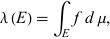 |
where the integral is the Lebesgue integral, for some integrable function  . The function
  is like a derivative, and is called the Radon-Nikodym
derivative
is like a derivative, and is called the Radon-Nikodym
derivative  .
Here, sigma-finiteness means that the underlying space is a countable union of measurable sets of finite
.
Here, sigma-finiteness means that the underlying space is a countable union of measurable sets of finite  -measure. The finiteness assumption on
  includes finite positive
measures and signed measures.
includes finite positive
measures and signed measures.
The measure supported at 0 ( iff
iff  ) is not absolutely continuous with respect to Lebesgue
measure, and is a singular measure.
) is not absolutely continuous with respect to Lebesgue
measure, and is a singular measure.
