


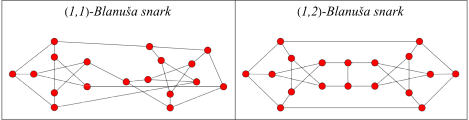
The original two Blanuša snarks were the second and third snarks discovered, found by Blanuša (1946). Orbanić et al. (2004) call the first the "Blanuša double" and the second the "Blanuša snark." Tutte wrote of the result, "I saw Blanuša's paper soon after it appeared. Alas, I did not understand the language, but the diagram made all clear!" The original two Blanuša snarks each have 18 vertices and edge chromatic number 4.
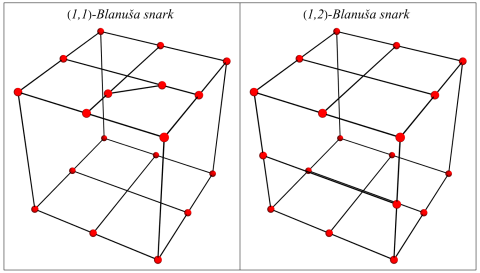
The original two Blanuša snarks are illustrated above in three-dimensional graph drawings due to Orbanić et al. (2004). Orbanić et al. (2004) also showed that the first Blanuša snark is of graph genus 2 (i.e., is double-toroidal), while the second has graph genus 1 (i.e., is toroidal).
The Blanuša snarks are used as the logo for the Croatian Mathematical Society (Ivanšić).
The Blanuša snarks are implemented in the Wolfram Language as GraphData[ "BlanusaSnark",
  n, k
n, k
 ]
for
]
for  to 4 and
  ,
2, with the original two Blanuša snarks corresponding to
,
2, with the original two Blanuša snarks corresponding to  .
.
The graph crossing number  , toroidal crossing
number
, toroidal crossing
number  ,
and graph genus
,
and graph genus  of the eight implemented Blanuša snarks are
summarized in the following table (E. Weisstein, Sep. 22, 2026). A dash
indicates that the value is not available.
of the eight implemented Blanuša snarks are
summarized in the following table (E. Weisstein, Sep. 22, 2026). A dash
indicates that the value is not available.
 |  |  |  |
 | 2 | 1 | 2 |
 | 2 | 0 | 1 |
 | 4 | 0 | 1 |
 | 4 | 1 | 2 |
 | 4 | 0 | 1 |
 | 4 | - | 2 |
 | 6 | 0 | 1 |
 | 6 | - | 2 |
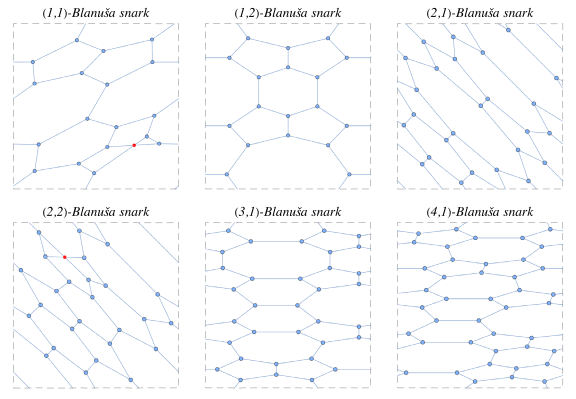
Five of the Blanuša snarks are illustrated above in graph drawings on the torus. The drawings for the  -,
-,  -, and
  -Blanuša snarks are torus
graph embeddings, while those for the
-Blanuša snarks are torus
graph embeddings, while those for the  - and
- and  -Blanuša snarks have one crossing
and realize toroidal crossing number 1.
-Blanuša snarks have one crossing
and realize toroidal crossing number 1.
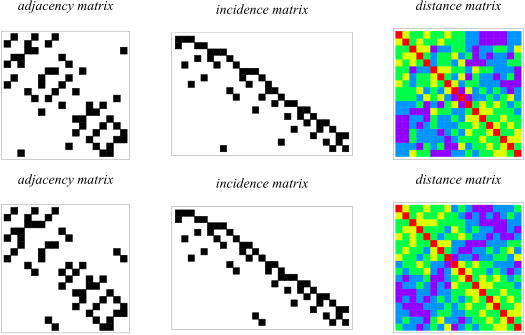
The plots above show the adjacency, incidence, and distance matrices of the first (top) and second (bottom) Blanuša snarks.
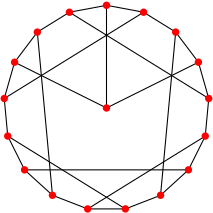
The first Blanuša snark was found independently in the drawing shown above by Collier and Schmeichel (1978) who erroneously characterized it as a "new cubic hypohamiltonian graph."
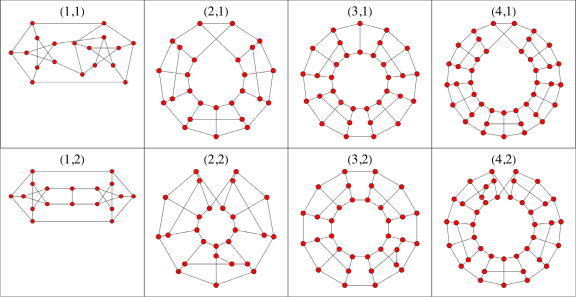
The "first and second Blanuša snarks" are actually the smallest members of two infinite families of snarks of graph
order  ,
i.e., Blanuša snarks of type 1 and 2 on 18, 26, 34, 42, ... vertices
(Read and Wilson 1998, p. 280), illustrated above.
,
i.e., Blanuša snarks of type 1 and 2 on 18, 26, 34, 42, ... vertices
(Read and Wilson 1998, p. 280), illustrated above.
Blanuša snarks are platypus graphs.
