


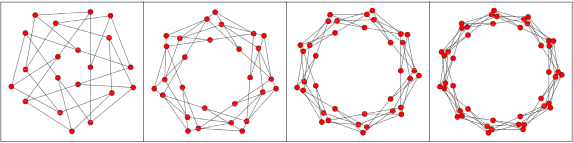
The flower snarks, denoted  for
 , 7, 9, ..., are a family of graphs
discovered by Isaacs (1975) which are snarks. They are
precisely the twisted Isaacs graphs
 for odd
 , whose closing permutation
is a transposition (Fouquet et al. 2010).
 appears in Scheinerman and Ullman
(2011, p. 96) as an example of a graph with edge
chromatic number and fractional
edge chromatic number (4 and 3, respectively) both integers
but not equal.
Flower snarks are unit-distance. They are also maximally nonhamiltonian (Clark and Entringer 1983) as well as platypus graphs.
The graph crossing number of  is 4, while that of
 is
 for every odd
 (Zheng et al. 2008, Lemmas 4.3 and 4.8).
Precomputed properties of flower snarks are implemented in the Wolfram Language as GraphData[ "Flower", n
 ].

 ." Master's thesis. Dalian, China: Dalian
University of Technology, 2007. In Chinese.Zheng, W.; Lin, X.; Yang,
Y.; and Yang, X. "The Crossing Number of Flower Snarks and Related Graphs."
Ars Combin. 86, 57-64, 2008.