An avoided crossing is the approach and subsequent separation of two eigenvalues of a matrix or linear operator
family without their becoming equal as a realparameter
varies. It is often called an avoided level crossing.
The gap
has minimum at . When , the two diagonal entries and instead cross at the origin.
For a general real symmetric matrix of size , a repeated eigenvalue
requires both
and .
These are two independent real conditions, so the
coincidence has codimension 2. For a Hermitian matrix,
the off-diagonal entry may be complex, and its
vanishing imposes two real conditions in addition
to ,
giving codimension 3 (von Neumann and Wigner 1929;
Seyranian et al. 2005, p. 1725). Thus an unconstrained family with one
realparameter generically
avoids such coincidences within either of these matrix
classes. Additional symmetry can permit an actual crossing.


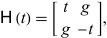
 and
 is a fixed nonzero real number. Its eigenvalues
are

 has minimum
 at
 . When
 , the two diagonal entries
 and
 instead cross at the origin.
 of size
 , a repeated eigenvalue
requires both
 and
 .
These are two independent real conditions, so the
coincidence has codimension 2. For a
 Hermitian matrix,
the off-diagonal entry may be complex, and its
vanishing imposes two real conditions in addition
to
 ,
giving codimension 3 (von Neumann and Wigner 1929;
Seyranian et al. 2005, p. 1725). Thus an unconstrained family with one
real parameter generically
avoids such coincidences within either of these matrix
classes. Additional symmetry can permit an actual crossing.
 ,
analytic continuation of the displayed family
to complex
 gives square-root branch
points at
 ,
where
 is the imaginary unit. At either value the matrix
is nonzero but its square vanishes, so the coincident eigenvalues
have only one independent eigenvector. These are
exceptional points. This model illustrates the
connection between avoided crossings for a real parameter and branch point
structure in the complex plane (Heiss and Steeb
1991). A diabolic point, in contrast, has two linearly independent eigenvectors
at a double eigenvalue.
