TOPICS
Search

Exceptional Point


An exceptional point, in the branch-point terminology for parameter-dependent spectra, is a branch point at which eigenvalues and their associated eigenvectors coalesce. For a matrix family, the usage here additionally requires the coalescing eigenvalue to have geometric multiplicity smaller than its algebraic multiplicity, making the matrix at that point a defective matrix (Heiss 2004, 2012).

A simple example is the analytic matrix family
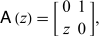
 A(z)=[0 1; z 0],
(1)

where z in C. Its eigenvalues are

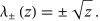
 lambda_+/-(z)=+/-sqrt(z).
(2)

For z!=0, corresponding eigenvectors are v_+/-(z)=(1,+/-sqrt(z))^T, where T denotes the transpose. At z=0, both eigenvalues vanish and both eigenvectors approach (1,0)^T. There is only one independent eigenvector, and A(0) is a nontrivial block in Jordan canonical form. Continuing around the origin once exchanges the two branches of sqrt(z), illustrating the monodromy of an algebraic branch point.

Since A(0)^2=0, the matrix exponential is

 e^(-itA(0))=I-itA(0).
(3)

The extra factor of t is a consequence of the nontrivial block in Jordan canonical form. For real t, acting on (0,1)^T gives (-it,1)^T, whose squared vector norm is 1+t^2 despite the matrix having only the zero eigenvalue.

Defectiveness alone does not ensure branching for a specified parameterization. Replacing z by z^2 in this example gives analytic eigenvalues z and -z while leaving the matrix at the origin defective. The branch-point usage distinguishes such a crossing from an exceptional point (Heiss 2012). Transitions between real and nonreal eigenvalues in parity-time symmetry provide another example.

An avoided crossing for a real parameter can reflect branch point structure at complex parameter values (Heiss and Steeb 1991). A diabolic point, in contrast, has two linearly independent eigenvectors at a double eigenvalue (Seyranian et al. 2005, pp. 1723-1725).


See also

Algebraic Branch Point, Algebraic Multiplicity, Avoided Crossing, Defective Matrix, Diabolic Point, Eigenvalue, Eigenvector, Geometric Multiplicity, Jordan Canonical Form, Monodromy, Parity-Time Symmetry

Explore with Wolfram|Alpha

References

Dembowski, C.; Dietz, B.; Gräf, H.-D.; Harney, H. L.; Heine, A.; Heiss, W. D.; and Richter, A. "Encircling an Exceptional Point." Phys. Rev. E 69, 056216, 2004. https://doi.org/10.1103/PhysRevE.69.056216.Heiss, W. D. "Exceptional Points of Non-Hermitian Operators." J. Phys. A: Math. Gen. 37, 2455-2464, 2004. https://doi.org/10.1088/0305-4470/37/6/034.Heiss, W. D. "The Physics of Exceptional Points." J. Phys. A: Math. Theor. 45, 444016, 2012. https://doi.org/10.1088/1751-8113/45/44/444016.Heiss, W. D. and Steeb, W.-H. "Avoided Level Crossings and Riemann Sheet Structure." J. Math. Phys. 32, 3003-3007, 1991. https://doi.org/10.1063/1.529044.Rotter, I. "Branch Points in the Complex Plane and Geometric Phases." Phys. Rev. E 65, 026217, 2002. https://doi.org/10.1103/PhysRevE.65.026217.Seyranian, A. P.; Kirillov, O. N.; and Mailybaev, A. A. "Coupling of Eigenvalues of Complex Matrices at Diabolic and Exceptional Points." J. Phys. A: Math. Gen. 38, 1723-1740, 2005. https://doi.org/10.1088/0305-4470/38/8/009.Ushveridze, A. G. "Analytic Properties of Energy Levels in Models with Delta-Function Potentials." J. Phys. A: Math. Gen. 21, 955-970, 1988. https://doi.org/10.1088/0305-4470/21/4/023.

Cite this as:

Weisstein, Eric W. "Exceptional Point." From MathWorld--A Wolfram Resource. https://mathworld.wolfram.com/ExceptionalPoint.html

Subject classifications