

The assembly number  of a finite connected simple graph
 with vertex set
 is the number of its assembly trees using the edge gluing
rule (Vince and Bóna 2012, p. 2). An assembly tree is a finite rooted tree whose nodes
are labeled by subsets of
 . Its leaves have the singleton
sets
 as labels, one for each
 ,
and its root vertex is labeled by
 . Each internal node has exactly
two unordered children. Their labels are disjoint
sets whose union is that node's
label, and an edge of
 joins a vertex in one child
label to a vertex in the other. Trees
are counted up to label-preserving graph isomorphism.
For  ,
an assembly tree has
 leaves and
 internal nodes. When
 , its sole node
is treated as a leaf in this assembly-tree convention. These trees
describe how vertex-induced subgraphs
join to form
 ,
a process motivated by the self-assembly of macromolecules in virus capsids (Kainen
2025, p. 220).
The assembly numbers for several parametrized graphs are summarized in the table below (Vince and Bóna 2012, pp. 4-7). The cycle graph formula applies for  , and the other rows apply for
 . Here,
 is a binomial coefficient,
 is a factorial,
and
 is a double factorial.
| family | OEIS | assembly number |
complete
bipartite graph  | A217523 | |
complete graph  | A001147 |  |
complete tripartite
graph  | A361072 | |
cycle graph  | A001700 |  |
path graph  | A000108 |  |
star graph  | A000142 |  |
If  is a Hamiltonian graph on
 vertices, then
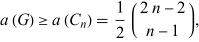 |
where  denotes the cycle graph on
 vertices. Similarly, if
 is a nonhamiltonian
graph on
 vertices with a Hamiltonian
path, then
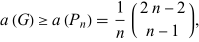 |
where  denotes the path graph on
 vertices.
