

The construction number  of a finite simple graph
  with vertex
set
with vertex
set  and edge set
  is the number of distinct construction sequences
for
is the number of distinct construction sequences
for  (Kainen 2025, p. 214). A construction sequence,
or c-sequence, for
(Kainen 2025, p. 214). A construction sequence,
or c-sequence, for  is a linear extension
of the partial order on
is a linear extension
of the partial order on  generated by requiring each edge
to follow both of its endpoints. Each graph vertex
and edge is a distinct object in these orders.
generated by requiring each edge
to follow both of its endpoints. Each graph vertex
and edge is a distinct object in these orders.

For example, for the path graph  with vertex set 1, 2, 3 and
edge set 12, 23, there are a total of 16 possible construction
sequences: (1, 2, 3, 12, 23), (1, 2, 3, 23, 12), (1,
2, 12, 3, 23), (1, 3, 2, 12, 23), (1, 3, 2, 23, 12), (2, 1, 3, 12, 23), (2, 1, 3,
23, 12), (2, 1, 12, 3, 23), (2, 3, 1, 12, 23), (2, 3, 1, 23, 12), (2, 3, 23, 1, 12),
(3, 1, 2, 12, 23), (3, 1, 2, 23, 12), (3, 2, 1, 12, 23), (3, 2, 1, 23, 12), (3, 2,
23, 1, 12), giving
with vertex set 1, 2, 3 and
edge set 12, 23, there are a total of 16 possible construction
sequences: (1, 2, 3, 12, 23), (1, 2, 3, 23, 12), (1,
2, 12, 3, 23), (1, 3, 2, 12, 23), (1, 3, 2, 23, 12), (2, 1, 3, 12, 23), (2, 1, 3,
23, 12), (2, 1, 12, 3, 23), (2, 3, 1, 12, 23), (2, 3, 1, 23, 12), (2, 3, 23, 1, 12),
(3, 1, 2, 12, 23), (3, 1, 2, 23, 12), (3, 2, 1, 12, 23), (3, 2, 1, 23, 12), (3, 2,
23, 1, 12), giving  .
.
The construction numbers for several parametrized graphs are summarized in the table below (Kainen 2025, pp. 216-221). The cycle
graph formula applies for  , and the other formulas apply for
  . Here,
  is the binomial coefficient,
 is a factorial,
  is a double factorial,
 is a Bernoulli number, and
  is the gamma function.
The determination of
is the gamma function.
The determination of  was proposed by Kainen et al. (2023) and solved
by Tauraso (2024). For the star graph
was proposed by Kainen et al. (2023) and solved
by Tauraso (2024). For the star graph  on
on  vertices, the cited OEIS A055546 gives the counts as absolute
values at index
vertices, the cited OEIS A055546 gives the counts as absolute
values at index  , rather than as its signed terms.
| family | OEIS | construction number |
complete
graph 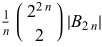 | A374928 |  |
cycle graph  | A024255 |  |
empty graph  | A000142 | 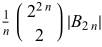 |
ladder rung graph  | A210277 |  |
path graph  | A000182 |  |
star graph  | A055546 |  |
