


A  -tree, for a positive
integer
 ,
is a graph obtained from the complete
graph
 by repeatedly adding a new graph vertex adjacent
to every graph vertex of one
 -clique and to no other vertices.
For example, for  ,
the first step adds a new graph vertex with one connecting
graph edge to a 1-clique
(graph vertex) of the path
graph
 , giving
 . Adding another graph vertex
with one connecting graph edge to
 gives the claw graph
 and
 . Similarly, a third iteration gives the star
graph
 ,
fork graph, and
 . As can be seen by this construction process, a 1-tree is
a tree with at least two vertices.
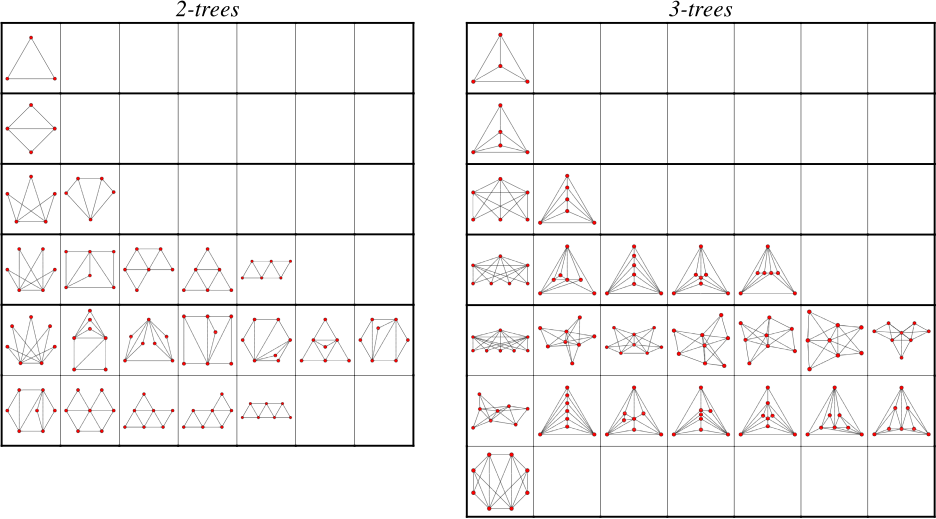
The first few 2-trees and 3-trees are illustrated above.
The case  gives the 2-trees,
which are maximal series-parallel graphs.
They include the maximal outerplanar and Dorogovtsev-Goltsev-Mendes graphs.
The  -trees correspond to the maximal graphs
with treewidth
 , where "maximal" means that the addition of any
graph edge would result in a larger treewidth.
Special  -trees are summarized in the following
table.

 -trees
 ,
Some polyhedral 3-trees on  nodes
are summarized below.
 | polyhedral 3-trees |
| 4 | tetrahedral graph  |
| 5 | 3-dipyramidal graph |
| 6 | tritetrahedral graph |
| 7 | 2-Apollonian network, 3-trees #s 3 and 5 |
| 8 | triakis tetrahedral graph, 7 of the triangulated graphs on 8 nodes |
| 11 | Goldner-Harary graph |
The numbers of  -trees
on
 , 2, ... nodes
are summarized in the table below. The table follows the definition above and starts
each family at
 .
Some of the cited OEIS sequences also include
 as a
 -tree,
giving 1 rather than 0 at
 .
 | OEIS | counts |
| 1 | A000055 | 0, 1, 1, 2, 3, 6, 11, 23, 47, 106, 235, 551, ... |
| 2 | A054581 | 0, 0, 1, 1, 2, 5, 12, 39, 136, 529, 2171, 9368, ... |
| 3 | A078792 | 0, 0, 0, 1, 1, 2, 5, 15, 58, 275, 1505, 9003, ... |
| 4 | A078793 | 0, 0, 0, 0, 1, 1, 2, 5, 15, 64, 331, 2150, ... |
| 5 | A201702 | 0, 0, 0, 0, 0, 1, 1, 2, 5, 15, 64, 342, ... |
 -trees are
 -uniquely colorable
(Xu 1990).

 -Species and the Enumeration of
 -Trees." Elec. J. Combin. 19, No. 4,
P45, 2012.
 -Trees." J. Combin., Information and System Sci. 11,
57-64, 1986.Sloane, N. J. A. Sequences