


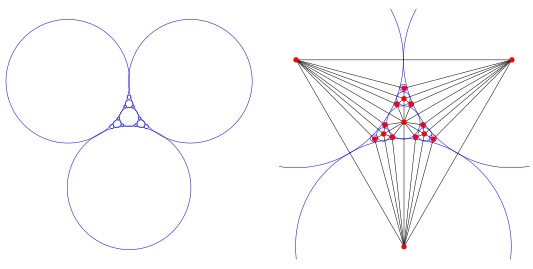
An Apollonian network is a graph whose vertices are the centers of the circles or spheres in an Apollonian gasket and whose edges join centers corresponding to tangent circles or spheres. The planar case is illustrated above. This network turns out to have some very special properties. In addition to being either deterministic or random, they are simultaneously scale-free, display small-world effects, can be embedded in a Euclidean lattice, and show space filling as well as matching graph properties. These networks describe force chains in granular packings, fragmented porous media, hierarchical road systems, and area-covering electrical supply networks (Andrade et al. 2005). Apollonian networks share many features of neuronal systems, and have been used to study the brain (Pellegrini et al. 2007).
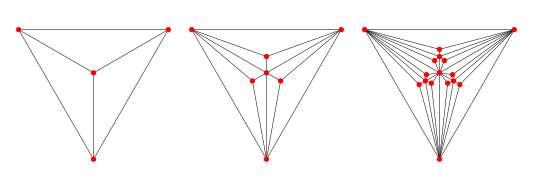
The first few two-dimensional Apollonian networks are illustrated above. The order-two network has the connectivity of the Fano plane.
Apollonian network graphs are implemented in the Wolfram Language as GraphData[ "Apollonian", n
 ].
].
In the Season 4 episode "Hollywood Homicide" (2007) of the television crime drama NUMB3RS, Larry Fleinhardt voices his concern that some of the work done by math genius Charlie Eppes on the subject of Apollonian networks was a bit on the subjective side.
