

A warping function in Saint-Venant torsion is a harmonic function on a plane cross section that describes
axial displacement during uniform twisting of a homogeneous, isotropic, linearly
elastic prismatic shaft. If  is the twist per unit length,
the axial displacement is
 (Lipton 1998, pp. 86-87). The warping function
is determined by the geometry and enters the calculation of torsional
rigidity.
Let  be a bounded, connected
plane domain whose boundary
consists of disjoint smooth curves, and let
 be its outward unit
normal vector. The defining boundary-value
problem is
 |  |  |
(1)
|
 |  |  |
(2)
|
where  is the two-dimensional Laplacian and
 . The Neumann
boundary conditions express the absence of traction on the lateral surface (Lipton
1998, p. 87). They apply to every boundary component,
including those surrounding holes. The divergence
theorem gives the compatibility condition
 |
(3)
|
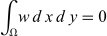
A solution exists and is unique up to an additive constant. The normalization
 |
(4)
|
selects a unique warping function.
The variational characterization uses the functional
 |
(5)
|
The warping function minimizes  over the Sobolev space
 of square-integrable real-valued functions whose first weak partial
derivatives are also square integrable.
No boundary values are prescribed in this minimization.
The minimum is the geometric multiplier
 in the torsional rigidity
 , where
 is the shear modulus (Lipton 1998, p. 89). Its weak
formulation is
 |
(6)
|
for every  .
Expanding the squares and using this identity yields
 |
(7)
|
This proves minimality and shows that all minimizers differ by a constant. In particular, testing with  gives
 |
(8)
|
where  is the polar area moment of inertia about
the origin. Consequently
 , with equality iff
 is constant. Any trial function
 therefore gives the upper bound
 .
For a disk  centered at the origin, the normal derivative
is zero and the normalized solution is
 . Thus
 |
(9)
|
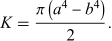
The same solution holds for a concentric annulus  , with
 , giving
 |
(10)
|
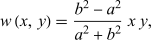
These cross sections undergo no axial warping. For the ellipse  , with positive semiaxes
 and
 , the solution is
 |
(11)
|
and its energy is
 |
(12)
|
These formulas agree with the displacement and torsional rigidity given by Timoshenko and Goodier (1951, pp. 264-265), after dividing
their axial displacement by  . For
 , the nonzero level curves
of
 lie on rectangular hyperbolas. The circular
limit
 recovers
 .
The harmonic displacement warping function differs from the Prandtl stress function used in the Poisson problem
formulation of torsional rigidity. For a simply connected domain,
define the normalized Prandtl stress function  by
 |  |  |
(13)
|
 |  |  |
(14)
|
Then  ,
and the additive constant can be chosen to impose zero
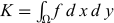
Dirichlet boundary conditions. With
this normalization
 .
For a domain with holes,
 is constant on each boundary
component, but these constants need not be equal.
