

The Prandtl stress function is a stress function whose first partial derivatives represent the
shear stresses in Saint-Venant torsion. For a homogeneous, isotropic, linearly elastic
shaft with shear modulus  , twist per unit length
 , and axis in the
 -direction, use the normalized scalar
function
 defined by
 |  |  |
(1)
|
 |  |  |
(2)
|
The dimensional stress potential is  . These formulas satisfy the shear equilibrium equation
identically (Timoshenko and Goodier 1951, pp. 260-262).
For a bounded, simply connected plane cross section  with a boundary consisting
of smooth curves, the normalized stress function
is the unique solution of the Poisson problem
 |  |  |
(3)
|
 |  |  |
(4)
|
Here  is the two-dimensional Laplacian. The zero Dirichlet
boundary conditions fix the additive constant allowed
by the traction-free sides. The torsional rigidity
is
 ,
where
 |
(5)
|
and the torque is  .
The same solution has a variational characterization. On the real Sobolev space  of functions with zero boundary
values, define
 |
(6)
|
The stress function is the unique maximizer, and
 |
(7)
|
Thus  ,
and every admissible trial function gives the lower
bound
 .
This is the stress-potential form of the variational formulation given by Lipton
(1998, p. 89). It complements the upper bound
obtained by minimizing the displacement energy of the warping
function.
For a disk  , with
 , the solution and geometric multiplier are
 |  |  |
(8)
|
 |  |  |
(9)
|
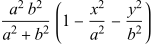
For an ellipse  , with
 , they are
 |  |  |
(10)
|
 |  |  |
(11)
|
The elliptic solution is given by Timoshenko and Goodier (1951, pp. 263-264).
With the sign convention above, the warping function  and normalized stress function satisfy
 |  |  |
(12)
|
 |  |  |
(13)
|
The normalized stress function  used in the torsional rigidity
formulas with
 is
 .
For a cross section with holes, choose  on the outer boundary. On
the boundary
 of the
 th hole,
 is an unknown constant
 .
Single-valuedness of the warping function imposes
 |
(14)
|
where  is the area of that hole and the unit
normal vector points out of the material into the hole. The geometric multiplier
becomes
 |
(15)
|
These additional boundary conditions and hole terms are essential (Franců and Rozehnalová-Nováčková
2015, pp. 8-12). For a concentric annulus  , with
 , the solution is still
 . Its inner boundary
value is
 ,
and the corrected formula gives
 .
