

The two-body problem is the n-body problem for two bodies of masses  under mutual Newtonian gravitational attraction.
Their center of mass moves with constant velocity,
while their relative position vector
 satisfies
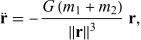 |
where  is the gravitational constant (Heggie 2006).
If the specific angular momentum  is nonzero, the motion
lies in a plane perpendicular
to
 . In polar coordinates,
with the angular origin chosen along the direction of closest approach,
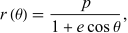 |
where  and
 is the eccentricity. The trajectory is an ellipse
for
 , a parabola for
 , and a hyperbola for
 . The case
 is a circle; zero
angular momentum instead gives radial motion.
By Newton's shell theorem, the same exterior interaction applies to two bodies with spherically symmetric mass distributions whose centers are separated by more than the sum of their outer radii.

 -Body Problem (Classical)." In Encyclopedia of Mathematical
Physics (Ed. J.-P. Françoise, G. L. Naber, and S. T. Tsou).
Oxford, England: Elsevier, pp. 575-582, 2006.