

Newton's shell theorem states that a uniform, infinitesimally thin spherical shell exerts no net gravitational force on a particle inside it, while its force on an exterior particle is the same as if all the shell's mass were concentrated at its center. The result assumes an inverse-square law for the force (McGrath 2018, pp. 111-113).
For a shell of radius  and mass
 , its gravitational scalar
potential at distance
 from the center, normalized
to vanish at infinity, is
 |
(1)
|
where  is the gravitational constant. The value at the center
is obtained by continuity. The gravitational field
is the negative gradient
of the scalar potential and hence
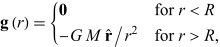 |
(2)
|
where  is the outward radial unit vector. The field has a
jump at the idealized shell.
Integrating over concentric shells proves that a spherically symmetric mass distribution of finite total mass supported within a sphere has the same exterior field as a point mass at its center. Consequently, two bodies with spherically symmetric mass distributions whose centers are separated by more than the sum of their outer radii attract one another as point masses located at their centers. This is an application of the superposition principle.
