

The  -body
problem is the initial value problem for
 bodies interacting through their mutual
Newtonian gravitational attraction. For positive masses
 and position vectors
 , the equations away from
collisions are
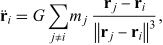 |
for  ,
where
 is the gravitational constant. Initial positions and velocities specify the initial
value problem (Heggie 2006).
These nonlinear ordinary differential equations form a Hamiltonian system. The total energy
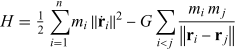 |
is an integral of motion, as are total linear and angular momentum. The center of mass moves with constant velocity. The virial theorem relates time-averaged kinetic and potential energies when its averaging hypotheses hold.
The two-body problem reduces to a single equation for the relative position, with nonradial trajectories that are conic sections. The three-body problem already has substantially richer dynamics, including special motions generated by central configurations.

 -Body Problem (Classical)." In Encyclopedia of Mathematical
Physics (Ed. J.-P. Françoise, G. L. Naber, and S. T. Tsou).
Oxford, England: Elsevier, pp. 575-582, 2006.