


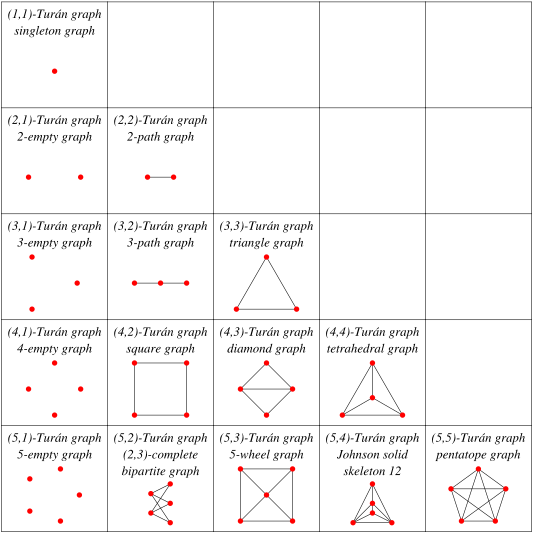
A Turán graph, sometimes called a maximally saturated graph (Zykov 1952, Chao and Novacky 1982), with positive
integer parameters  and
 is a type of extremal
graph on
 vertices originally considered by Turán (1941).
There are unfortunately two different conventions for the index
 .
In the more standard terminology (and that adopted here), the  -Turán graph, sometimes also called a K-graph and
variously denoted
 ,
 (Gross and Yellen 2006, p. 476),
 (Chao and Novacky 1982), or
 (Pach and Agarwal 1995, p. 120),
is the extremal graph on
 graph vertices that contains
no
 -clique
for
 (Chao and Novacky 1982;
Diestel 1997, p. 149; Bollobás 1998, p. 108). In other words, the
Turán graph has the maximum possible number of graph
edges of any
 -vertex simple graph
not containing a complete graph
 . The Turán graph is also the complete
k-partite graph on
 vertices whose partite sets
are as nearly equal in cardinality as possible (Gross and Yellen 2006, p. 476).
Unfortunately, some authors, including Skiena (1990, pp. 143-144), Aigner (1995), and Pemmaraju and Skiena (2003, pp. 247-248), use the convention that the  -Turán graph contains no
 -clique (instead
of
 -clique),
meaning that the
 -Turán
graph of these authors is the
 -Turán graph as defined above.
The Turán graph on  vertices that does not contain the complete
graph
 can be generated in the Wolfram Language
using TuranGraph[n,
k] and precomputed properties are available using GraphData[
 "Turan",
 n, k

 ].
Turán graphs may be obtained by dividing a set of graph vertices  into
 pairwise disjoint subsets of cardinalities
 , ...,
 that differ by at most 1 and satisfy
 |
(1)
|
and with two graph vertices joined iff they lie in distinct graph vertex sets. Such graphs
are sometimes denoted  .
They can be directly constructed by numbering the vertices 0, 1, ...,  and connecting vertices by an edge iff the vertices are incongruent
modulo
 (König 1936, Chao and Novacky 1982).
Turán's theorem gives the number of edges  for the
 -Turán graph as
 |
(2)
|
where  and
 denotes the floor
function. This gives the number triangle
 |
(3)
|
(OEIS A198787).
Turán graphs are chromatically unique (Chao and Novacky 1982). If  , then the Turán graph
 is a balanced
complete multipartite graph and hence is strongly
regular unless
 ,
since
 is excluded by the convention used here. A Turán graph is regular iff
 .
The chromatic number of  is
 (Chao and Novacky 1982).
Special cases of Turán graphs are summarized in the following table, where  is a positive
integer and
 in the
 row.
| graph class | Turán graph |
complete graph  |  |
 |  |
complete
bipartite graph  |  |
 -cocktail party graph |  |
complete tripartite graph  |  |
empty
graph  |  |
For  , the Turán graph
 has
 maximal cliques, where
 and
 are nonnegative integers
satisfying
 and
 . This is the largest number
possible among all
 -vertex simple graphs
(Moon and Moser 1965). The singleton graph
 has one maximal
clique.
