

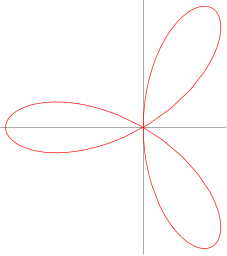
The trifolium is the three-petalled rose curve, equivalently the Kepler's folium with  . It is also known as the paquerette de mélibée
(Apéry 1987, p. 85), with paquerette being the French word for
"wild daisy."
Lawrence (1972) defines a trifolium as a Kepler's folium with  , but this more general definition
is not so commonly used.
For  , the trifolium with a lobe along
the negative x-axis has polar
equation
 |
(1)
|
 |
(2)
|
The Cartesian equation can also be written in the alternative form
 |
(3)
|
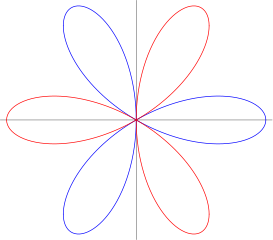
The trifolium and its reflection in the y-axis together have Cartesian equation
 |
(4)
|
The area of the trifolium is given by
 |  |  |
(5)
|
 |  |  |
(6)
|
 |  |  |
(7)
|
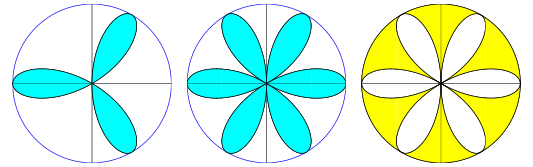
The area of the trifolium (left figure) is exactly one quarter of the area of the circumscribed circle. The combined area of the two reflected trifoliums (middle figure) is half the area of this circle, equal to the area inside the circle and outside their union (right figure).
The arc length of the trifolium is
 |  |  |
(8)
|
 |  |  |
(9)
|
(OEIS A093728), where  is a complete
elliptic integral of the second kind.
For the parametrization  ,
 with
 , the accumulated arc
length from
 ,
curvature, and tangential
angle measured from the initial tangent are
 |  |  |
(10)
|
 |  |  |
(11)
|
 |  |  |
(12)
|
where  is an incomplete elliptic
integral of the second kind with modulus
 , and
 is the floor function. At
 , the tangential angle is defined by its continuous
limiting value.
The trifolium is the deltoid radial curve.
