

The total variation  of a complex measure
  is the positive measure
which measures the size of
is the positive measure
which measures the size of  without cancellation. In particular,
  on a subset
  is the largest sum of "variations" for any subdivision
of
is the largest sum of "variations" for any subdivision
of  .
Roughly speaking, a total variation measure is an infinitesimal version of the absolute value.
.
Roughly speaking, a total variation measure is an infinitesimal version of the absolute value.
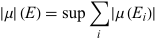
More precisely,
 |
(1)
|
where the supremum is taken over all partitions  of
of  into measurable subsets
  .
.
Note that  may not be the same as
  .
When
.
When  already is a positive measure, then
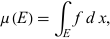
  . More generally, if
  is absolutely continuous,
that is
is absolutely continuous,
that is
 |
(2)
|
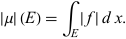
then so is  ,
and the total variation measure can be written as
,
and the total variation measure can be written as
 |
(3)
|
The total variation measure can be used to rewrite the original measure, in analogy to the norm of a complex number. The measure  has a polar
representation
has a polar
representation
 |
(4)
|
with  .
.
For a real-valued function  on
on ![[a,b]](/images/equations/TotalVariation/Inline19.svg) , total variation is defined by
, total variation is defined by
 |
(5)
|
where the supremum is over all finite partitions of the interval. A function has bounded
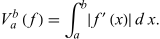
variation when this quantity is finite. If  is continuously differentiable, then
 |
(6)
|
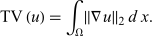
For a differentiable image  on a planar domain
  , the isotropic total variation is
 |
(7)
|
Penalizing this quantity favors images that are nearly constant in regions while permitting sharp edges (Rudin et al. 1992). Total variation minimization is therefore used as a regularizer in compressed sensing, including reconstruction of undersampled magnetic resonance images (Lustig et al. 2007).
