

The Riesz representation theorem has two standard forms. For a Hilbert space  ,
every bounded linear functional
,
every bounded linear functional  on
on  has a unique representing vector
  such that
  for every
  , and
, and  .
.
The Riesz-Markov-Kakutani form concerns a locally compact T2-space  .
Every bounded linear functional
.
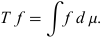
Every bounded linear functional  on the space
  of continuous complex-valued functions vanishing at infinity
is represented by a unique regular complex Borel measure
of continuous complex-valued functions vanishing at infinity
is represented by a unique regular complex Borel measure  such that
 |
Moreover,  ,
where
,
where  is the total variation of
  . The functional
  is positive iff
  is a positive measure.
