

A stacked (or generalized) prism graph  is a simple graph given
by the graph Cartesian product
 (Gallian 2025, p. 217) for positive
integers
 and
 with
 .
Stacked prism graphs are sometimes also called
 -prism graphs or cylinder graphs (Mertens 2024). When
 , they are prism
graphs, also called circular ladder graphs (Gross and Yellen 1999, p. 14).
By analogy with the KC graph and KP
graph, the stacked prism graph could also be called a "CP graph." The
term "web graph" is sometimes also used to
refer to a stacked prism graph (e.g., Horvat and Pisanski 2010), while in the convention
used here a web graph is obtained from
 by removing the edges
of its outer cycle.
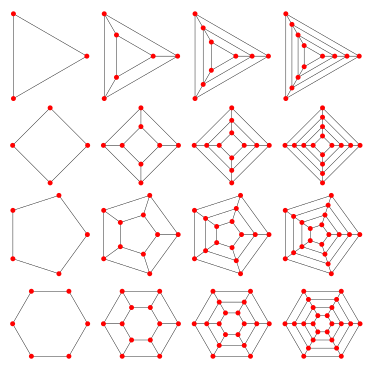
A stacked prism graph can also be formed by connecting  concentric cycle graphs
 along spokes that begin at the innermost
and end at the outermost cycle.
 therefore has
 vertices and
 edges. Several are illustrated
above.
Special cases are summarized in the following table.


Since stacked prism graphs are a graph Cartesian product of two unit-distance graphs, they are themselves unit-distance graphs (Horvat and Pisanski 2010).
Precomputed properties of generalized prism graphs are implemented in the Wolfram Language as GraphData[ "StackedPrism",
 m, n

 ].
Mertens (2024) computed the domination polynomial and numbers of dominating sets for stacked prism
graphs  up to
 .
