


A space-filling pentahedron is a pentahedron whose congruent copies can tile three-dimensional Euclidean space. A convex space-filling pentahedron must have the combinatorial type of either a square pyramid or a triangular prism. Its combinatorial type does not, however, fix its geometric realization.
Goldberg (1972) tabulated the then-known space-filling pentahedra, most of which have one or more variable parameters, noting that the list might not be complete. Goldberg (1974) added further constructions based on newly discovered space-filling tetrahedra. He also emphasized that his numbered types are methods of generation rather than mutually exclusive classes, since special parameter values can make different types equivalent.
Another example is the Mekhontsev wedge, a triangular-prism-type pentahedron that is an order-8 rep-tile.
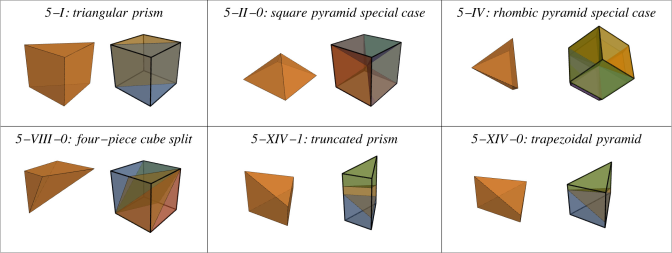
The six examples illustrated above are exact special representatives of Goldberg types 5-I, 5-II-0, 5-IV, 5-VIII-0, 5-XIV-1, and 5-XIV-0. In each panel, the orange solid at left is one pentahedron and the multicolored solid at right is a prism, cube, or other cell assembled from congruent copies.
