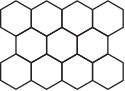
In two dimensions, a honeycomb is the regular tessellation  consisting of regular hexagons (i.e., a hexagonal
grid).
consisting of regular hexagons (i.e., a hexagonal
grid).
In general, the term honeycomb is used to refer to a tessellation in  dimensions for
  . The only regular honeycomb in three dimensions is
  , which consists of eight cubes
meeting at each polyhedron vertex. The only
quasiregular honeycomb (with regular cells and semiregular vertex
figures) is the tetrahedral-octahedral
honeycomb. It has each polyhedron vertex
surrounded by eight tetrahedra and six octahedra and is denoted
, which consists of eight cubes
meeting at each polyhedron vertex. The only
quasiregular honeycomb (with regular cells and semiregular vertex
figures) is the tetrahedral-octahedral
honeycomb. It has each polyhedron vertex
surrounded by eight tetrahedra and six octahedra and is denoted  .
.
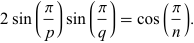
Ball and Coxeter (1987) use the term "sponge" for a solid that can be parameterized by integers  ,
,  ,
and
,
and  that satisfy the equation
The possible sponges are  ,
,
 ,
,  ,
,  , and
, and  .
.
There are many semiregular honeycombs, such as  , in which each polyhedron
vertex consists of two octahedra
, in which each polyhedron
vertex consists of two octahedra  and four cuboctahedra
  .
.
See also
Hexagon,
Hexagonal Grid,
Honeycomb Conjecture,
Menger
Sponge,
Regular Tessellation,
Tessellation,
Tetrahedral-Octahedral Honeycomb,
Tetrix,
Tiling
Explore with Wolfram|Alpha
References
Ball, W. W. R. and Coxeter, H. S. M. "Regular Sponges." In Mathematical
Recreations and Essays, 13th ed. New York: Dover, pp. 152-153, 1987.Bulatov,
V. "Infinite Regular Polyhedra." https://bulatov.org/polyhedra/infinite/.Coxeter,
H. S. M. "Regular Honeycombs in Hyperbolic Space." Proc. International
Congress of Math., Vol. 3. Amsterdam, Netherlands: pp. 155-169, 1954.Coxeter,
H. S. M. "Space Filled with Cubes," "Other Honeycombs,"
and "Polytopes and Honeycombs." §4.6, 4.7, and 7.4 in Regular
Polytopes, 3rd ed. New York: Dover, pp. 68-72 and 126-128, 1973.Cromwell,
P. R. Polyhedra.
New York: Cambridge University Press, p. 79, 1997.Gott, J. R.
III "Pseudopolyhedrons." Amer. Math. Monthly 73, 497-504,
1967.Wells, D. The
Penguin Dictionary of Curious and Interesting Geometry. London, England:
Penguin, pp. 104-106, 1991.Williams, R. The
Geometrical Foundation of Natural Structure: A Source Book of Design. New
York: Dover, 1979.Referenced on Wolfram|Alpha
Honeycomb
Cite this as:
Weisstein, Eric W. "Honeycomb." From MathWorld--A Wolfram Resource. https://mathworld.wolfram.com/Honeycomb.html
Subject classifications