


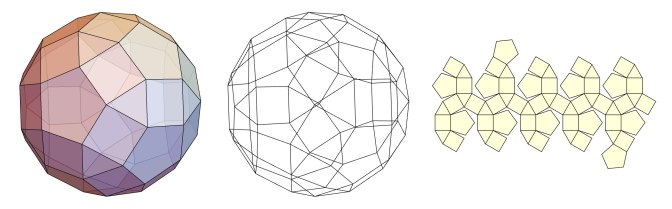

The (small) rhombicosidodecahedron (Cundy and Rollett 1989, p. 111), sometimes simply called the rhombicosidodecahedron
(Wenninger 1989; Maeder 1997; Conway et al. 1999), is the 62-faced Archimedean
solid with faces  .
It is also the uniform polyhedron with Maeder
index 27 (Maeder 1997), Wenninger index 14 (Wenninger 1989), Coxeter index 30 (Coxeter
et al. 1954), and Har'El index 32 (Har'El 1993). It is illustrated above together
with a wireframe version and a net that can be used for its
construction.
It has Schläfli symbol r and Wythoff symbol
 . The small
dodecicosidodecahedron and small rhombidodecahedron
are faceted versions.
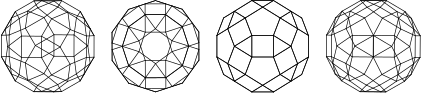
Some symmetric orthogonal projections of the small rhombicosidodecahedron are illustrated above.
It is implemented in the Wolfram Language as UniformPolyhedron["Rhombicosidodecahedron"]. Precomputed properties are available as PolyhedronData["SmallRhombicosidodecahedron", prop].
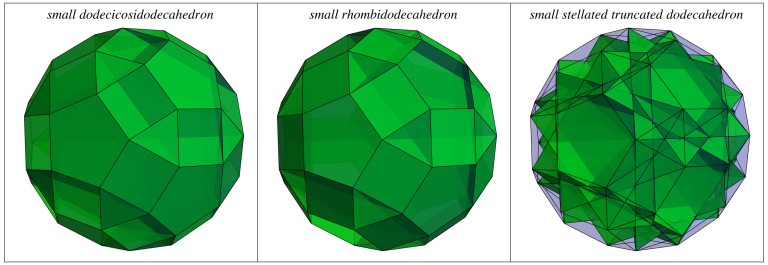
The small rhombicosidodecahedron is the convex hull of the small dodecicosidodecahedron, small rhombidodecahedron, and small stellated truncated dodecahedron.
The inradius  of the dual polyhedron,
midradius
 of the solid and dual polyhedron,
and circumradius
 of the solid for
 are
 |  |  |
(1)
|
 |  |  |
(2)
|
 |  |  |
(3)
|
The unit small rhombicosidodecahedron has surface area
 |
(4)
|
and volume
 |
(5)
|
The Dehn invariant of the unit small rhombicosidodecahedron has the following representative in the basis of Conway et al. (1999):
 |  |  |
(6)
|
 |  |  |
(7)
|
 |  |  |
(8)
|
The decimal expansion of  is given by OEIS A377606.
The small rhombicosidodecahedron can be dissected
into the metabigyrate rhombicosidodecahedron,
parabigyrate rhombicosidodecahedron,
and trigyrate rhombicosidodecahedron,
from which it differs only by the relative rotations
of two or three cupolae.
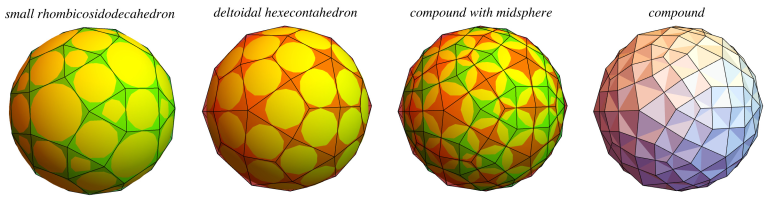
The dual polyhedron of the small rhombicosidodecahedron is the deltoidal hexecontahedron, both of which are illustrated above together with their common midsphere.
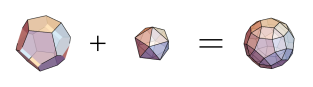
The Minkowski sum of a unit regular dodecahedron and unit regular icosahedron in dual position is a small rhombicosidodecahedron.
Hervay (2026) gives a computer-assisted proof that the small rhombicosidodecahedron is a nopert polyhedron, meaning that it does
not have Rupert's property. This settles the
conjecture of Steininger and Yurkevich (2023) and gives the first Archimedean
solid proved not to have the property. The proof covers the symmetry-reduced
configuration space with 192696 regions verified using exact arithmetic in  . Its Nieuwland
number is therefore 1.

 ." §3.7.11 in