where
and basis polynomials with indices outside on the right are zero (Farin 1993). The two terms
come from
and ,
respectively. Applying this recurrence to a Bernstein
expansion replaces adjacent coefficients by their linear interpolants. The de Casteljau algorithm repeats this step to
evaluate the expansion or a Bézier curves.
The envelope of the Bernstein polynomials for , 1, ..., (Mabry 2003) is given by
Bernstein, S. "Démonstration du théorème de Weierstrass fondée sur le calcul des probabilities." Comm. Soc.
Math. Kharkov13, 1-2, 1912.Farin, G. Curves
and Surfaces for Computer Aided Geometric Design. San Diego, CA: Academic
Press, 1993.Farin, G. "The Bernstein Form of a Bézier Curve."
Ch. 6 in Curves
and Surfaces for Computer Aided Geometric Design, 3rd ed. San Diego, CA:
Academic Press, pp. 41-63, 1993. https://doi.org/10.1016/B978-0-12-249052-1.50009-X.Farouki,
R. T. "The Bernstein Polynomial Basis: A Centennial Retrospective."
Comput. Aided Geom. Des.29, 379-419, 2012. https://doi.org/10.1016/j.cagd.2012.03.001.Farouki,
R. T. and Rajan, V. T. "Algorithms for Polynomials in Bernstein Form."
Comput. Aided Geom. Des.5, 1-26, 1988. https://doi.org/10.1016/0167-8396(88)90016-7.Feller,
W. An
Introduction to Probability Theory and Its Applications, Vol. 2, 3rd ed.
New York: Wiley, p. 222, 1971.Kac, M. "Une remarque sur les
polynomes de M. S. Bernstein." Studia Math.7, 49-51,
1938.Kac, M. "Reconnaissance de priorité relative à
ma note, 'Une remarque sur les polynomes de M. S. Bernstein.' " Studia
Math.8, 170, 1939.Lorentz, G. G. Bernstein
Polynomials. Toronto, Ontario, Canada: University of Toronto Press, 1953.Mabry,
R. "Problem 10990." Amer. Math. Monthly110, 59, 2003.Mathé,
P. "Approximation of Hölder Continuous Functions by Bernstein Polynomials."
Amer. Math. Monthly106, 568-574, 1999.Widder, D. V.
The
Laplace Transform. Princeton, NJ: Princeton University Press, p. 101,
1941.


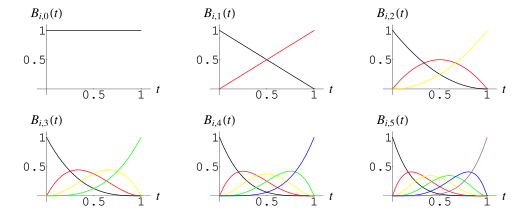

 is a binomial coefficient. The Bernstein
polynomials of degree
 form a basis for the power
polynomials of degree
 . The first few polynomials are


 , normalization

 with
 has a single unique local maximum of

 .

 and basis polynomials with indices outside
 on the right are zero (Farin 1993). The two terms
come from
 and
 ,
respectively. Applying this recurrence to a Bernstein
expansion replaces adjacent coefficients by their linear interpolants. The de Casteljau algorithm repeats this step to
evaluate the expansion or a Bézier curves.
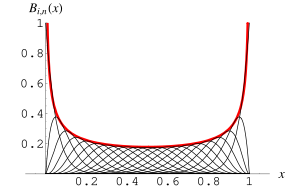
 of the Bernstein polynomials
 for
 , 1, ...,
 (Mabry 2003) is given by

 .
