

A Schrödinger bridge is a probability measure on paths that has prescribed initial and final marginal
distributions and is closest in relative entropy
to a given reference path measure. If  is the reference measure and
  are the required endpoint distributions, the Schrödinger bridge
is the solution of
are the required endpoint distributions, the Schrödinger bridge
is the solution of
 |
where  is the relative entropy of
  with respect to
  .
.
When the reference measure is the law of a Markov process, the minimizing measure is also the law of a Markov process and, under suitable regularity conditions, has the form
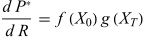 |
for nonnegative endpoint factors  and
and  . The intermediate marginal
distributions form an entropic interpolation between
. The intermediate marginal
distributions form an entropic interpolation between  and
and  . When the endpoint distributions
are point masses, the construction reduces to a Markov
bridge; for a Brownian reference process it includes the Brownian
bridge as a special case.
. When the endpoint distributions
are point masses, the construction reduces to a Markov
bridge; for a Brownian reference process it includes the Brownian
bridge as a special case.
The problem was introduced by Schrödinger (1931) in connection with the unlikely evolution of a large collection of independent particles between two observed distributions. It is also closely connected with control theory and with variational problems for transporting probability distributions (Léonard 2014).
