

A Doob  -transform
is a change of measure that constructs a new Markov
process by reweighting transitions of an original process using a positive eigenfunction
-transform
is a change of measure that constructs a new Markov
process by reweighting transitions of an original process using a positive eigenfunction  . If
. If  is the transition semigroup
of the original process and its infinitesimal
generator
is the transition semigroup
of the original process and its infinitesimal
generator  satisfies
  ,
the transformed semigroup is
,
the transformed semigroup is
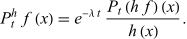 |
(1)
|
Its infinitesimal generator is therefore
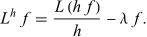 |
(2)
|
When the process has transition densities  , the transformed densities are
 |
(3)
|
The case  uses a positive harmonic
function
uses a positive harmonic
function  .
Space-time versions of the construction condition a process on a future endpoint.
Taking
.
Space-time versions of the construction condition a process on a future endpoint.
Taking  produces the corresponding Markov bridge to
  at time
  .
.
Doob (1957) used this transformation to construct conditioned Brownian motion and relate it to boundary limits of harmonic functions.
