

A Markov bridge is a Markov process conditioned to begin at a specified state and arrive at another specified state at a fixed later
time. Let  denote the transition density of a time-homogeneous Markov
process. The density of the bridge from
denote the transition density of a time-homogeneous Markov
process. The density of the bridge from  at time 0 to
  at time
  , evaluated at an intermediate time
  , is
, is
 |
(1)
|
More generally, its transition density between times  is
is
 |
(2)
|
These formulas apply where the ratios are defined. They follow from conditional probability and the defining conditional-independence property of a Markov process. They also show that a bridge is generally time-inhomogeneous even when the original process is time-homogeneous.
For a continuous-time Markov chain with transition rates  ,
conditioning on arrival at state
,
conditioning on arrival at state  at time
  gives the off-diagonal rates
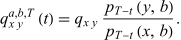 |
(3)
|
This formula gives the rates for  . The diagonal rates are chosen so that the total rate in
each row is zero. This is a space-time Doob h-transform
with
. The diagonal rates are chosen so that the total rate in
each row is zero. This is a space-time Doob h-transform
with  .
A Brownian bridge is the corresponding construction
for Brownian motion.
.
A Brownian bridge is the corresponding construction
for Brownian motion.
