

The Schnakenberg system is a planar mass-action system for two chemical species (Schnakenberg 1979). A dimensionless form for
the concentrations  and
 is
 |  |  |
(1)
|
 |  |  |
(2)
|
where  and primes denote derivatives of
 and
 with respect to time
 . The opposite signs of
 represent conversion of one unit of
 into one of
 by autocatalysis. Adding the two equations gives
 . Writing
 , the unique positive equilibrium
point is
 . The Jacobian
at this point has determinant
 and trace
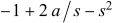 , so its two eigenvalues
are purely imaginary when the trace vanishes. If
 and
 with
 , varying
 through
 makes the pair of eigenvalues
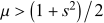
cross the imaginary axis. The resulting supercritical Hopf
bifurcation produces a small attracting limit cycle
on the side where
 . Adding diffusion
terms gives a spatially dependent system of partial
differential equations for the two concentrations.
