TOPICS
Search

Hopf Bifurcation


A Hopf bifurcation is a bifurcation in which a limit cycle emerges from or disappears into an equilibrium point as a parameter varies (Tabor 1989, p. 197). The supercritical Stuart-Landau equation gives an attracting limit cycle with radius proportional to the square root of the distance from the bifurcation value (Guckenheimer and Holmes 1983, pp. 150-154).
HopfBifurcation

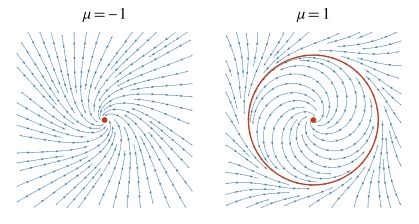
The figure illustrates the supercritical case in polar coordinates, with radial equation r^'=mur-r^3 and angular equation theta^'=1, where primes denote derivatives with respect to time. For mu=-1, the origin attracts nearby trajectories. For mu=1, the origin repels them and the circle r=1 is an attracting limit cycle.


See also

Bifurcation, Dynamical System, Limit Cycle, Stuart-Landau Equation

Explore with Wolfram|Alpha

References

Casti, J. L. "The Hopf Bifurcation Theorem." Ch. 2 in Five More Golden Rules: Knots, Codes, Chaos, and Other Great Theories of 20th-Century Mathematics. New York: Wiley, pp. 35-99, 2000.Guckenheimer, J. and Holmes, P. Nonlinear Oscillations, Dynamical Systems, and Bifurcations of Vector Fields. New York: Springer-Verlag, pp. 150-154, 1983. https://doi.org/10.1007/978-1-4612-1140-2.Marsden, J. and McCracken, M. Hopf Bifurcation and Its Applications. New York: Springer-Verlag, 1976.Tabor, M. Chaos and Integrability in Nonlinear Dynamics: An Introduction. New York: Wiley, p. 197, 1989.

Referenced on Wolfram|Alpha

Hopf Bifurcation

Cite this as:

Weisstein, Eric W. "Hopf Bifurcation." From MathWorld--A Wolfram Resource. https://mathworld.wolfram.com/HopfBifurcation.html

Subject classifications
