

The trace of an  square matrix
  is defined to be
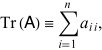 |
(1)
|
i.e., the sum of the diagonal elements. The matrix trace is implemented in the Wolfram Language as Tr[list].
For square matrices  and
and  ,
it is true that
,
it is true that
 |  |  |
(2)
|
 |  |  |
(3)
|
 |  |  |
(4)
|
(Lang 1987, p. 40), where  denotes the transpose. The
trace is also invariant under a similarity
transformation
denotes the transpose. The
trace is also invariant under a similarity
transformation
 |
(5)
|
(Lang 1987, p. 64). Since
 |
(6)
|
(where Einstein summation is used here to sum over repeated indices), it follows that
 |  |  |
(7)
|
 |  |  |
(8)
|
 |  |  |
(9)
|
 |  |  |
(10)
|
 |  |  |
(11)
|
where  is the Kronecker delta.
The trace of a product of two square matrices is independent of the order of the multiplication since
 |  |  |
(12)
|
 |  |  |
(13)
|
 |  |  |
(14)
|
 |  |  |
(15)
|
 |  |  |
(16)
|
(again using Einstein summation). Therefore, the trace of the commutator of  and
and  is given by
![Tr([A,B])=Tr(AB)-Tr(BA)=0.](/images/equations/MatrixTrace/NumberedEquation4.svg) |
(17)
|
The trace of a product of three or more square matrices, on the other hand, is invariant only under cyclic permutations of the order of multiplication of the matrices, by a similar argument.
The product of a symmetric and an antisymmetric matrix has zero trace,
 |
(18)
|
The trace of a  rotation matrix representing a rotation through angle
 can be found by choosing a coordinate
system in which the z-axis lies along the axis
of rotation. In this coordinate system, the matrix is
can be found by choosing a coordinate
system in which the z-axis lies along the axis
of rotation. In this coordinate system, the matrix is
![A^'=[cosphi sinphi 0; -sinphi cosphi 0; 0 0 1],](/images/equations/MatrixTrace/NumberedEquation6.svg) |
(19)
|
so the trace is
 |
(20)
|
where  is interpreted as Einstein summation notation.
In group theory, the group character of a group representation is the function that assigns to each group element the trace of its matrix under the representation.
