

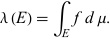
The Radon-Nikodym theorem asserts that any finite complex measure  that is absolutely continuous with respect
to a sigma-finite positive measure
that is absolutely continuous with respect
to a sigma-finite positive measure  (such as Lebesgue measure
on
(such as Lebesgue measure
on  )
is given by the integral of some
)
is given by the integral of some  -function
  ,
,
 |
(1)
|
The function  is like a density function for the measure.
A closely related theorem says that any complex measure  decomposes into an absolutely
continuous measure
decomposes into an absolutely
continuous measure  and a singular measure
  . This is the Lebesgue
decomposition,
. This is the Lebesgue
decomposition,
 |
(2)
|
One consequence of the Radon-Nikodym theorem is that any complex measure has a polar representation
 |
(3)
|
with  .
.
