

 is the value of the Riemann zeta function
at 5, given by
is the value of the Riemann zeta function
at 5, given by
 |  |  |
(1)
|
 |  |  |
(2)
|
(OEIS A013663).
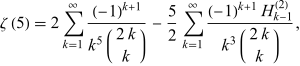
A binomial sum identity is
 |
(3)
|
where  is a binomial coefficient and
 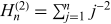 is a generalized harmonic
number (Borwein and Bradley 1996).
is a generalized harmonic
number (Borwein and Bradley 1996).
Rapidly converging series include
 |
(4)
|
(Plouffe 1998). Related series are
 |  |  |
(5)
| ||
 |  |  |  |  |
(6)
|
(Plouffe 2006).
Huvent (2002) gave the series
![zeta(5)=-(16)/(11)sum_(n=1)^infty([2(-1)^n+1]H_n)/(n^4),](/images/equations/RiemannZetaFunctionZeta5/NumberedEquation3.svg) |
(7)
|
where  is a harmonic number. A sum limit
is
is a harmonic number. A sum limit
is
![zeta(5)=lim_(x->infty)1/((2x+1)^5)sum_(k=1)^x[cot(k/(2x+1))]^5](/images/equations/RiemannZetaFunctionZeta5/NumberedEquation4.svg) |
(8)
|
(Apostol 1973, given incorrectly in Stark 1974), where  tends to infinity through positive
integers.
tends to infinity through positive
integers.
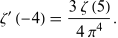
The derivative of the Riemann zeta function satisfies
 |
(9)
|
Fauzan (2026) announced a proof that  is irrational.
The construction uses rationally normalized determinants
of Hankel matrices to produce integer
polynomials
is irrational.
The construction uses rationally normalized determinants
of Hankel matrices to produce integer
polynomials  of degree
  satisfying
 |
(10)
|
for all sufficiently large positive integers  .
A moment representation with a positive
weight proves that these determinants do not vanish
at
.
A moment representation with a positive
weight proves that these determinants do not vanish
at  .
An analytic estimate bounds their values, while local arithmetic estimates ensure
integer coefficients after normalization and preserve
the required decay.
.
An analytic estimate bounds their values, while local arithmetic estimates ensure
integer coefficients after normalization and preserve
the required decay.
To obtain a proof by contradiction, suppose  with
with  an integer and
  a positive integer. Since
 is an integer polynomial of degree
  ,
the number
,
the number  is an integer and satisfies
 |
(11)
|
For fixed  ,
the right-hand side tends to zero as
,
the right-hand side tends to zero as  , contradicting the fact that a positive
integer is at least 1.
, contradicting the fact that a positive
integer is at least 1.
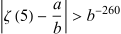
Fauzan (2026) also reports the bound
 |
(12)
|
for every integer  and all sufficiently large positive
integer denominators
and all sufficiently large positive
integer denominators  . The irrationality measure
of
. The irrationality measure
of  therefore satisfies
 |
(13)
|
Lean implementations of the proof are available with different assumptions and estimates. Romik (2026) reports a formal verification that  is irrational,
assuming the prime number theorem as an additional
axiom. The Zeta5 project (mo271 2026) uses a formalized
prime number theorem and reports that the
final theorem depends only on the standard logical axioms used by Lean. Its normalizing factor and local estimates
differ from those in Fauzan (2026), and its decay estimate suffices to prove that
is irrational,
assuming the prime number theorem as an additional
axiom. The Zeta5 project (mo271 2026) uses a formalized
prime number theorem and reports that the
final theorem depends only on the standard logical axioms used by Lean. Its normalizing factor and local estimates
differ from those in Fauzan (2026), and its decay estimate suffices to prove that
 is irrational without reproducing the constant
 above.

 ."
Amer. Math. Monthly 80, 425-431, 1973.Borwein, J. M.
and Bradley, D. M. "Searching Symbolically for Apéry-Like Formulae
for Values of the Riemann Zeta Function." ACM SIGSAM Bull. Algebraic Sym.
Manip. 30, 2-7, 1996.
."
Amer. Math. Monthly 80, 425-431, 1973.Borwein, J. M.
and Bradley, D. M. "Searching Symbolically for Apéry-Like Formulae
for Values of the Riemann Zeta Function." ACM SIGSAM Bull. Algebraic Sym.
Manip. 30, 2-7, 1996.  Is Irrational." Preprint. 17 Sep 2026.
  ." Feb. 3, 2002.
  Pegg, E. Jr. "Basel, Hankel, and a Recent Proof of
  Irrationality." Wolfram Community. Oct. 7,
2026.
Irrationality." Wolfram Community. Oct. 7,
2026.  Is Irrational: A Lean 4 Formalization of A. Fauzan's Proof." GitHub, 2026.
 ,
3, 4, ..., Once More." Math. Mag. 47, 197-202, 1974.
,
3, 4, ..., Once More." Math. Mag. 47, 197-202, 1974.