


The Riemann-Siegel formula is a formula discovered (but not published) by Riemann for computing an asymptotic formula for the Riemann-Siegel
function  .
The formula was subsequently discovered in an archive of Riemann's papers by C. L. Siegel
(Edwards 2001, p. 136, Derbyshire 2004, pp. 257 and 263) and published
by Siegel in 1932.
.
The formula was subsequently discovered in an archive of Riemann's papers by C. L. Siegel
(Edwards 2001, p. 136, Derbyshire 2004, pp. 257 and 263) and published
by Siegel in 1932.
The Riemann-Siegel formula states that
![Z(t)∼2sum_(k=1)^(nu(t))1/(sqrt(k))cos[theta(t)-tlnk]+R(t),](/images/equations/Riemann-SiegelFormula/NumberedEquation1.svg) |
(1)
|
where
 |  |  |
(2)
|
 |  |  |
(3)
|
 |  | ![[omega^k]{exp[i(ln(t/(2pi))-1/2t-1/8pi-theta(t))]×[y^0][(sum_(j=0)^(infty)A_j(y)omega^j)(sum_(j=0)^(infty)(psi^((j))(p))/(j!)y^j)]}](/images/equations/Riemann-SiegelFormula/Inline10.svg) |
(4)
|
 |  |  |
(5)
|
 |  |  |
(6)
|
 |  | ![(cos[2pi(p^2-p-1/(16))])/(cos(2pip))](/images/equations/Riemann-SiegelFormula/Inline19.svg) |
(7)
|
 is the floor function (Edwards 2001), and
 ![[y^k]](/images/equations/Riemann-SiegelFormula/Inline21.svg) is coefficient notation. The first few terms
is coefficient notation. The first few terms
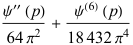
 are given by
 |  |  |
(8)
|
 |  |  |
(9)
|
 |  |  |
(10)
|
 |  |  |
(11)
|
 |  |  |
(12)
|
 |  |  |
(13)
|
The numerators and denominators are 1,  , 1, 1,
  ,
,  ,
,  , 1, 19, 11, 1,
  ,
,  , ... (OEIS A050276)
and 1, 96, 64, 18432, 64, 3840, 5308416, 128, ... (OEIS A050277),
respectively.
, ... (OEIS A050276)
and 1, 96, 64, 18432, 64, 3840, 5308416, 128, ... (OEIS A050277),
respectively.
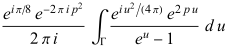
It is based on evaluation of the integral
 |  |  |
(14)
|
 |  | ![(cos[2pi(p^2-p-1/(16))])/(cos(2pip)),](/images/equations/Riemann-SiegelFormula/Inline52.svg) |
(15)
|
also denoted  ,
where
,
where  is a line segment of slope 1, directed from upper right to lower left, which crosses
the imaginary axis between 0 and
is a line segment of slope 1, directed from upper right to lower left, which crosses
the imaginary axis between 0 and  (Edwards 2001, p. 147).
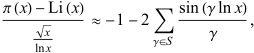
Another formula ascribed to Riemann and Siegel is the one presented by Riemann in his groundbreaking 1859 paper,
 |
(16)
|
where  is the prime counting function,
  is the logarithmic
integral, and
is the logarithmic
integral, and  is the set of
  such that
  and
and  is a (nontrivial) zero of the Riemann
zeta function
is a (nontrivial) zero of the Riemann
zeta function  . Here, the left side is the overcount of
  as an estimator for the prime
counting function normalized by the apparent size of the error term (Borwein
and Bailey 2003, p. 68).
as an estimator for the prime
counting function normalized by the apparent size of the error term (Borwein
and Bailey 2003, p. 68).
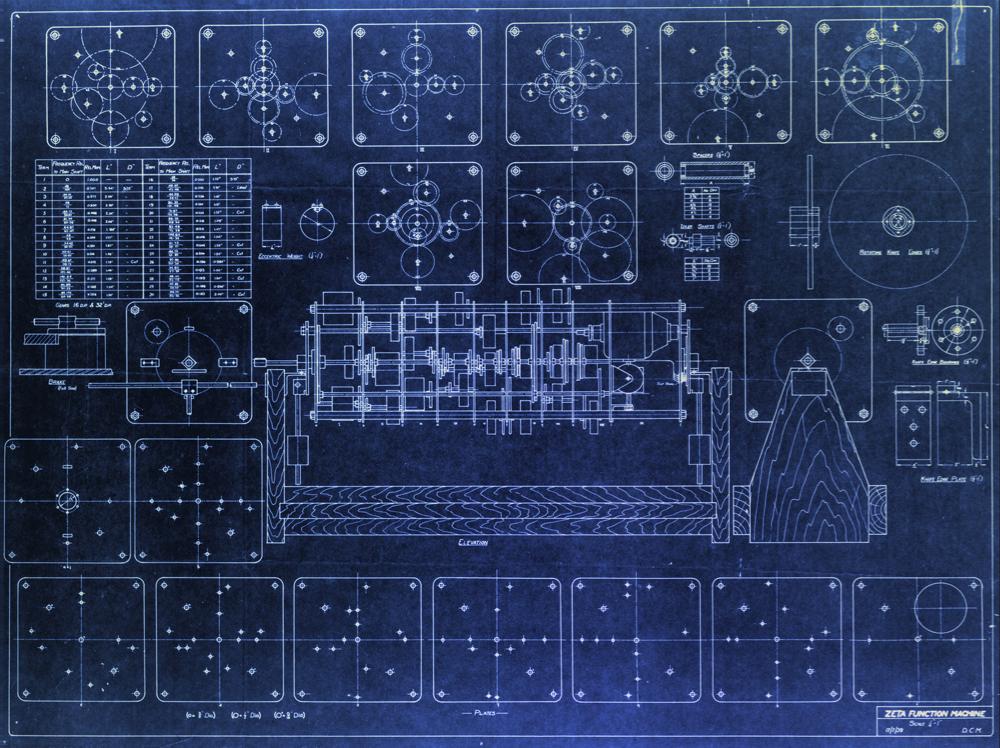
In 1939, Alan Turing designed a gear-driven analog machine intended to tabulate the cosine terms in the Riemann-Siegel sum and thereby assist a search for zeros of the Riemann zeta function. The surviving blueprint was never built and contains several mechanical errors, but it anticipates Turing's later computer calculations of zeta zeros (Casselman 2006).
