

A rainbow subgraph of a vertex-colored graph is a subgraph whose vertices have pairwise distinct colors (Angles d'Auriac et al. 2016). In a graph with an edge coloring, a rainbow subgraph is a subgraph whose edges have pairwise distinct colors.
If a rainbow subgraph is also tropical, then it is a colorful subgraph.
For a graph  , let
 be the least number of colors in an edge
coloring of some graph on
 vertices with at least
 edges in
which every copy of
 is a rainbow subgraph. Shahab (2026) proved
 |
(1)
|
with  tending to zero as
 in little-O notation, where
 is the floor function.
Together with the result of Bucić et al. (2026) for
 , this proves the Burr-Erdős-Graham-Sós
conjecture
 |
(2)
|
for every fixed integer  . This is Problem
809 in the Erdős problems collection.
Chao et al. (2026) proved that a simple graph with  edges and an edge coloring
using
 colors has at most
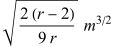 |
(3)
|
rainbow triangles, meaning rainbow copies of the cycle graph  . The constant is sharp
whenever an affine plane of order
 exists. In that case, the extremal graphs
are balanced graph blow-ups of the complete
graph on the points of such an affine
plane, with colors assigned by parallel classes
of lines, together with possible isolated
vertices.
For every  , Xu (2026, Theorem 1.1) proved that,
for all sufficiently large integers
 and all
 , every finite simple graph with
 edges and at most
 edges of each color contains
at least
 rainbow forests with pairwise disjoint edge sets, each with exactly
 edges. The edge
coloring need not be proper. For every
 , a graph
on
 vertices with
 differently colored edges has
no
 -edge
forest, showing that the parameter range cannot be extended
in general. The color bound is also sharp. A matching
with
 edges, using
 colors each
 times, has no rainbow forest
of size
 . Xu (2026) credits Codex with identifying the edge-count
lemma and shorter proof that removed the proper-coloring
assumption, and ChatGPT with helping develop the argument.
