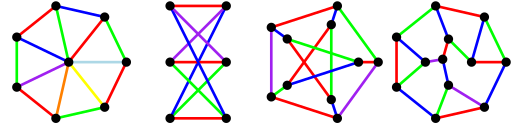
An edge coloring of a graph  assigns colors to its edges
such that any two edges incident on the same graph
vertex receive different colors. An edge coloring containing the smallest possible
number of colors for a given graph is known as a minimum
edge coloring. Finding a minimum edge coloring
is the edge coloring problem.
assigns colors to its edges
such that any two edges incident on the same graph
vertex receive different colors. An edge coloring containing the smallest possible
number of colors for a given graph is known as a minimum
edge coloring. Finding a minimum edge coloring
is the edge coloring problem.
The edge chromatic number gives the minimum number of colors with which a graph's edges
can be colored.
See also
Chromatic Number,
Colorful Cycle,
Coloring,
Edge
Chromatic Number,
Edge Coloring Problem,
Graph Coloring,
k-Coloring,
Labeled Graph,
Minimum
Edge Coloring,
Minimum Vertex Coloring,
Proper Coloring,
Vertex
Coloring
Explore with Wolfram|Alpha
References
Fiorini, S. and Wilson, R. Edge-Colourings of Graphs. Pittman, 1977.Saaty, T. L. and Kainen, P. C.
The
Four-Color Problem: Assaults and Conquest. New York: Dover, p. 13, 1986.Referenced
on Wolfram|Alpha
Edge Coloring
Cite this as:
Weisstein, Eric W. "Edge Coloring." From
MathWorld--A Wolfram Resource. https://mathworld.wolfram.com/EdgeColoring.html
Subject classifications